
Business/Products
SANKEN, The University of Osaka
The Institute for Solid State Physics, The University of Tokyo
College of Science and Engineering, Aoyama Gakuin University
artience Co., Ltd.
Developing colorless, transparent solar cells that generate electricity using invisible light
This page has been translated using AI.
[Key Points of the Research Results]
- Successfully developed a colorless, transparent organic solar cell (OSC) (* 2) that generates electricity using invisible "near-infrared light (* 1)"
- Established design technology for organic semiconductors that transmit visible light (* 3) and absorb only near-infrared light, as well as technology to convert near-infrared light energy into electricity.
- Expected to be a colorless, transparent solar cell that can generate electricity on building and car windows without compromising daylight or scenery
About
A joint research group consisting of Assistant Professor Soichi Yokoyama and Professor Yutaka Ie of the SANKEN at the University of Osaka, the Graduate School of Engineering at the University of Osaka, the Institute for Solid State Physics at the University of Tokyo, the College of Science and Engineering at the Aoyama Gakuin University and artience Co., Ltd., has succeeded in developing a colorless, transparent organic solar cell (OSC) that can generate electricity using near-infrared light, which is invisible to the human eye.
OSC is expected to be one of the next-generation energy technologies due to its flexibility and lightweight design. On the other hand, conventional OSC absorbs visible light to generate electricity, making it appear colored, which poses challenges for applications in places where lighting and aesthetic appeal are required.
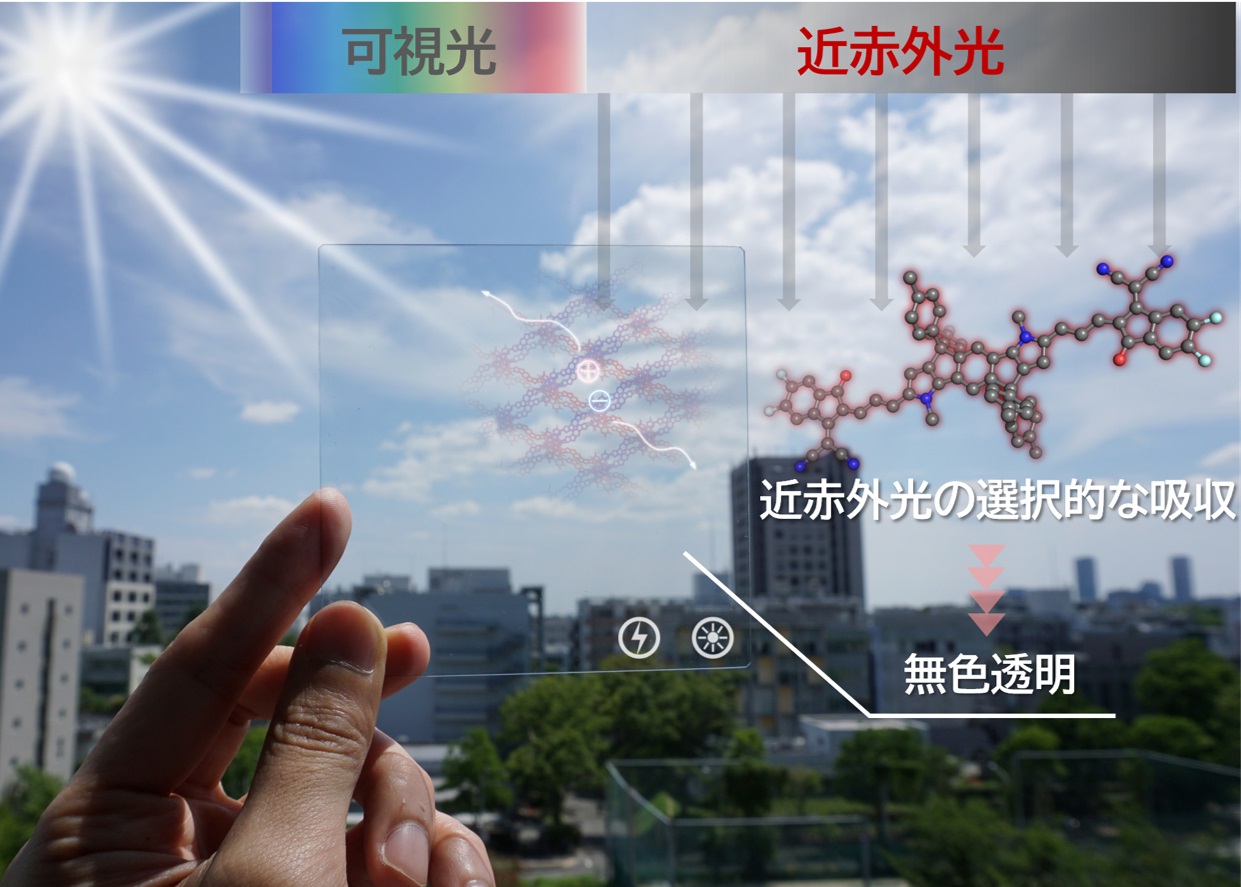
In this study, the research group developed an organic semiconductor material that selectively absorbs almost no visible light and selectively absorbs near-infrared light. By using this material, they confirmed that organic solar cells can generate electricity while maintaining high transparency (Figure 1).
With these achievements, it is expected that next-generation transparent power generation devices that can be integrated into buildings, car windows, and wearable devices (* 4) will be deployed.
The results of this research will be published online in the "Journal of the American Chemical Society" on Tuesday, August 4.
[Comment from Professor Yutaka Ie]
Near-infrared light has lower energy than visible light and is not easy to utilize in solar cells. In this study, precise molecular design has achieved both colorless transparency and power generation functionality. We hope that the results of this research will lead to the development of next-generation colorless transparent organic solar cells and wearable devices for healthcare.
Background of the Research
Solar cells are a clean energy technology that emits almost no carbon dioxide during power generation. To further expand the adoption of solar cells, it is important to utilize not only rooftops and vast lands but also familiar spaces such as buildings, car windows, and agricultural greenhouses—which have not been sufficiently utilized until now—as power generation sites. Currently mainstream silicon solar cells and next-generation perovskite solar cells demonstrate high power generation performance, but selectively utilizing sunlight for power generation is not easy.
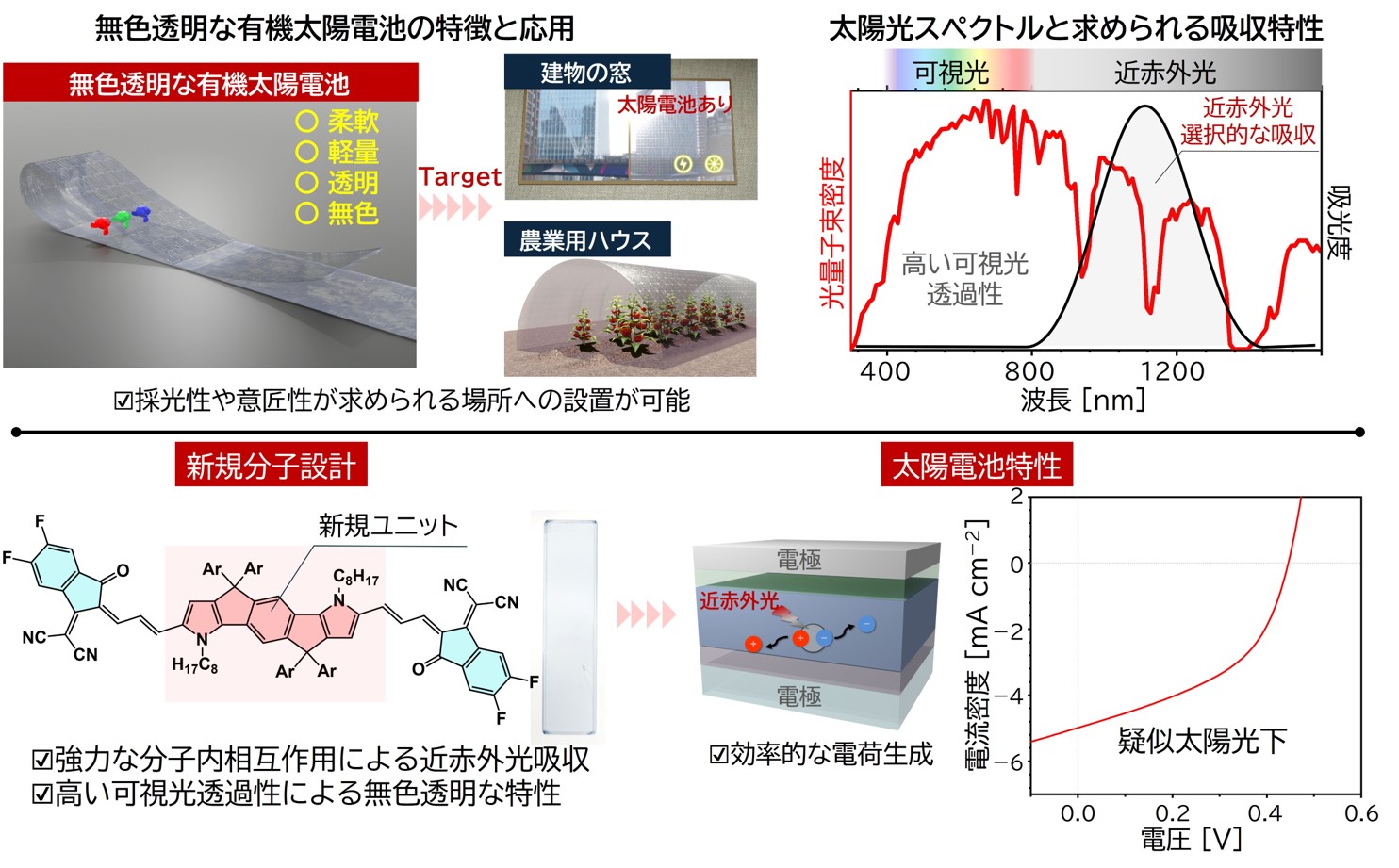
Against this backdrop, lightweight and flexible OSCs that can control the wavelength of sunlight using organic semiconductor designs have attracted attention. On the other hand, conventional OSCs mainly absorb visible light to generate electricity, causing changes in the color balance of transmitted and reflected light, resulting in colored appearances. Therefore, there were challenges in applying them to locations requiring daylight and aesthetic appeal. Therefore, there was a need to develop new OSCs that combine "colorless transparency" and "power generation functions," where visible light passes through and generates electricity using invisible near-infrared light (see Figure 2 top).
Research Content
The research group has so far developed molecular design guidelines that selectively absorb near-infrared light by precisely controlling the structure and electronic state of organic semiconductor materials (press release June 2024). Based on these design guidelines, we designed a novel unit that induces strong intramolecular interactions and incorporated it into the molecule to develop a new material that transmits visible light while absorbing near-infrared light. This thin film efficiently absorbs near-infrared light while exhibiting high visible light transmittance, appearing almost colorless and transparent to the naked eye (Figure 2, bottom left). Furthermore, the developed molecule tends to generate charge (* 5) after absorbing near-infrared light, and the resulting charge can be efficiently transported within the thin film. As a result, solar cells incorporating this molecule into the power generation layer operated while maintaining high visible light transparency (bottom right of Figure 2) and demonstrated external quantum efficiencies exceeding 20% in the near-infrared spectrum (* 6).
Impact of this research results on society (significance of these research results)
This achievement leads to technology that adds power generation functions to locations that were difficult to install with conventional solar cells without compromising landscape, visibility, or daylight. Additionally, since it can absorb part of the near-infrared light for power generation, it is expected to reduce heat shielding effects and power consumption required for air conditioning. Furthermore, this research has succeeded in pulse detection using near-infrared light using the colorless transparent organic photoelectric conversion device we developed. This is expected to enable deployment in wearable devices for healthcare that can be worn discreetly, as well as self-powered sensors powered by ambient light.
Special Notes
The results of this research will be published online in the American scientific journal "Journal of the American Chemical Society" on Tuesday, August 4.
Title: "Laporte-Rule-Guided Molecular Symmetry Control of NIR-Selective Organic Semiconductors for Colorless and Transparent Photovoltaics"
Authors: Soichi Yokoyama, Kenta Kuroishi, Shunsuke Tanaka, Yuta Murotani, Ryusuke Matsunaga, Shuhei Kawaoka, Reo Ohno, Miki Hasegawa, Akinori Saeki, Jun Yoshinobu, Yutaka Ie
DOI:10.1021/jacs.6c05512
This research was supported by Grants-in-Aid for Scientific Research (20H02814, 20H05836, 20H05841, 20KK0123, 20KAKK15352, 21K14602, 23K17947, 24H00482, 24K08553, JP20H05832), JST A-step Research Promotion Project (22713577, JPMJSF23B3), This program was carried out with support from the JST Future Society Creation Project (JPMJMI22I1), A-step (JPMJSF23B3), JST CREST (JPMJCR20R1, JPMJCR20R4), the Mitsubishi Foundation (202310004), the Cabinet Office's Science and Technology and Innovation Council, and the BRIDGE program with Society 5.0, titled "Development of Heat Countermeasure Technologies for Facility Production Where Productivity Has Significantly Declined Due to Global Warming."
Glossary
* 1 Near-Infrared Light
Invisible light corresponds to wavelengths ranging from about 780 nm to a few micrometers in sunlight. It accounts for about 30~40% of sunlight's energy, and most near-infrared light reaching the Earth's surface is converted into heat.
* 2 Organic Solar Cells (OSC)
OSC stands for Organic Solar Cell. A solar cell that uses organic semiconductor materials as the power generation layer. Compared to silicon solar cells, it has characteristics such as being lighter, thinner, bendable, and capable of printing over large areas.
* 3 Visible Light
The light contained in sunlight corresponds to wavelengths around 400-780 nm, and is perceived by the human eye. Depending on the wavelength band, it appears in different colors such as blue, green, and red.
* 4 Wearable Devices
A small device worn on the body. There are wristwatch-type and patch-type devices that can be attached to the skin, and are used to measure health status and biometric information such as heart rate and pulse.
* 5 Charge
Particles charged with electricity, such as electrons or holes. In OSC, electrons with negative charges generated by light absorption and holes with positive charges move to the electrode and are extracted as current.
* 6 External Quantum Efficiency
The ratio of the number of photons incident into the solar cell to the number of charges taken as current into the external circuit. A higher value indicates that the incident light is efficiently converted into electricity.
SDGs Goals





Reference URL
Assistant Professor Soichi Yokoyama - Researcher Overview
https://rd.iai.osaka-u.ac.jp/ja/72b7a111b430651d.html
Professor Yutaka Ie Researcher List
https://rd.iai.osaka-u.ac.jp/ja/3cc5087df5e9219c.html
Home Laboratory (Osaka University Institute of Industrial Science) Website
https://www.sanken.osaka-u.ac.jp/labs/omm/
Saeki Laboratory (Graduate School of Engineering, Osaka University) Website
http://www.chem.eng.osaka-u.ac.jp/~saeki/cmpc/
Yoshinobu Laboratory (Institute for Solid State Physics, University of Tokyo) Website
https://yoshinobu.issp.u-tokyo.ac.jp/
Hasegawa Laboratory (Department of Chemistry and Life Sciences, Faculty of Science and Technology, Aoyama Gakuin University) Website
https://www.agnes.aoyama.ac.jp/chem/hasegawa/
Matsunaga Laboratory (Institute for Solid State Physics, University of Tokyo) Website
https://matsunaga.issp.u-tokyo.ac.jp/index.html
artience Co., Ltd. Website
https://www.artiencegroup.com
###
Inquiries
<Inquiries regarding research>
Professor, Institute of Scientific and Industrial Research, Osaka University
Yutaka Ie
TEL: +81-6-6879-8475
Email: yutakaie@sanken.osaka-u.ac.jp
<Inquiries regarding public relations>
Public Relations Office, SANKEN, The University of Osaka
TEL: +81-6-6879-8524
E-mail: press@sanken.osaka-u.ac.jp
Public Relations Office, The Institute for Solid State Physics, The University of Tokyo
TEL: +81-4-7136-3207
E-mail: press@issp.u-tokyo.ac.jp
Aoyama Gakuin University, Policy and Planning Department, University Public Relations Section
TEL: +81-3-3409-8159
Interview and Photography Application Form: https://www.aoyama.ac.jp/companies/interview.html
artience Co., Ltd. Corporate Communication Department
TEL: +81-3-3272-5720
Email: info@artiencegroup.com
Share


