
Structural color materials that do not use pigments (developed product)
This website uses automated machine translation. Please note that translations may not be fully accurate and may differ from the original Japanese text.
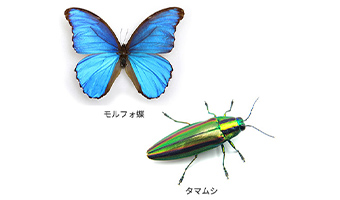
The bright colors of organisms such as morpho butterflies and tadpoles are colored by a mechanism called structural color. It is a mechanism that produces color due to diffraction and interference of light due to a regular structure at intervals similar to the wavelength of light, rather than by light absorption by light absorption.
We have developed structural color materials that do not use pigments or dyes as new color materials.
We have developed structural color materials that do not use pigments or dyes as new color materials.
Features of the developed product
It has the characteristics of excellent color development and a high degree of freedom in the design of colors.
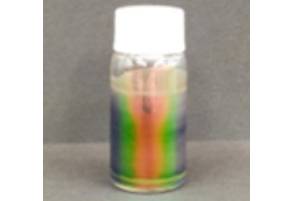
- Exhibits vivid structural colors even in thin films
The color that can be seen changes depending on the angle, giving it excellent design quality - Sharp reflection and transmission spectra
- Wide substrate selectivity
- pigments & dye-free and eco-friendly
Characteristics of the developed product
| maximum reflection wavelength | 350-800 nm (blue-red) |
|---|---|
| reflected light intensity | 25~35% |
| Half width | 20-35 nm |
| Applicable base material | PET, PP, Glass, Aluminum, Paper, Canvas |
| Coloring layer thickness | 5~20μm |
Techniques for expressing structural colors
Monodisperse fine particle synthesis technology x periodic array technology
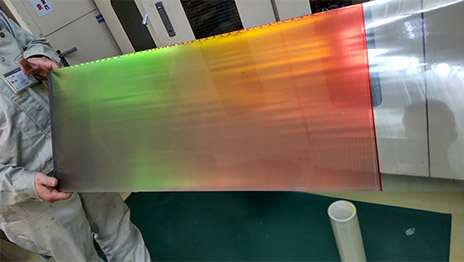
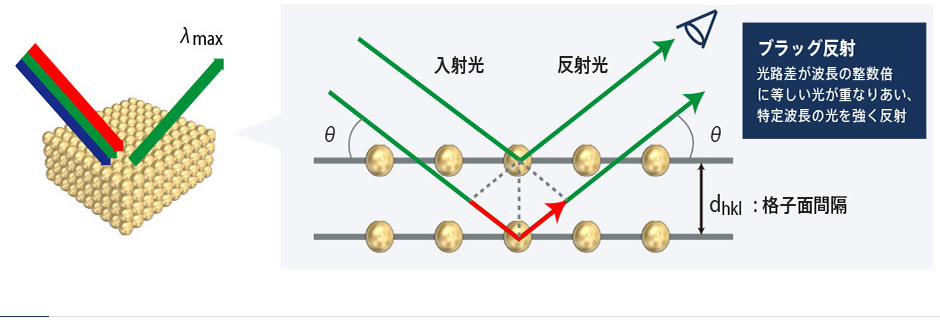
The material that expresses structural color is called photonic crystal and has a nanoperiodic structure whose refractive index changes at intervals similar to the wavelength of light. Photonic crystals exhibit characteristic color and optical properties, such as vivid color development and color changes depending on the viewing angle, due to light diffraction and interference when light is inrushed.
Photonic crystals are classified into several types according to their structure, but since we have a high degree of design freedom, we focused on colloidal crystals with a structure in which fine particles are arranged in a three-dimensional order.
Photonic crystals are classified into several types according to their structure, but since we have a high degree of design freedom, we focused on colloidal crystals with a structure in which fine particles are arranged in a three-dimensional order.
Application example
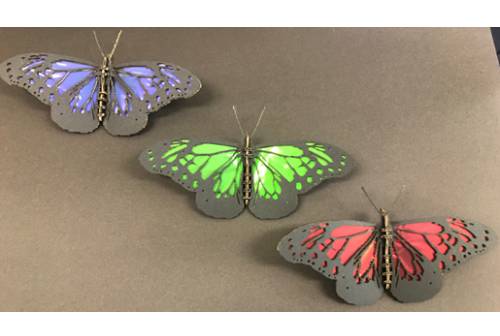
It is expected to be developed for a variety of applications, such as art materials and spot decorations, where you can take advantage of its excellent color development.
It can be painted with a brush, brush, airbrush, etc.
We will support you if you want to use it in a place like this.
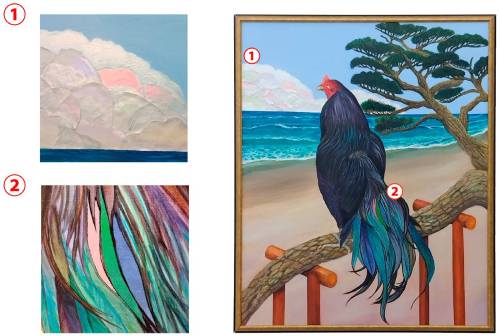
Painter: Kiyoko Yamazaki (General Exhibition)
Title: Satsuma Chicken (All Black)
Material: oil paint, acrylic, ink, medium, cloth, canvas
Size: F100 (Length 162cm x Width 130.3cm)
* Structural Color Usage: Tail Feathers, Clouds
Title: Satsuma Chicken (All Black)
Material: oil paint, acrylic, ink, medium, cloth, canvas
Size: F100 (Length 162cm x Width 130.3cm)
* Structural Color Usage: Tail Feathers, Clouds
Share


Inquiries
artience Co., Ltd. Group R&D Division
TEL:+81-3-3272-5732