
Integrated Report 2026Governance Talks: A blueprint for artience's transformation to increase its corporate value
Published on June 30, 2026
This page has been translated using AI.
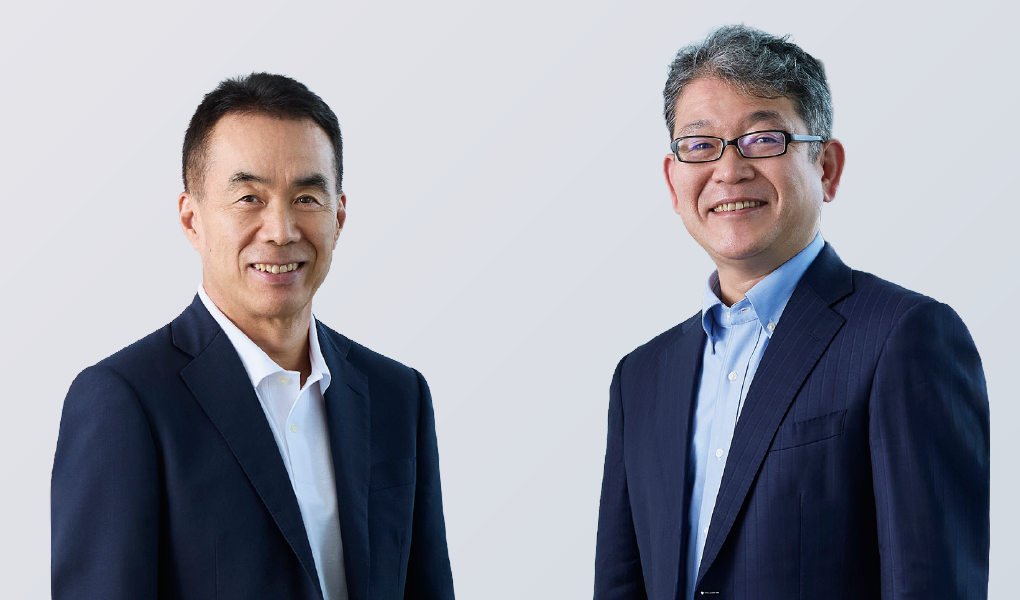
A researcher and businessperson specializing in sustainable finance and environmental policies. Before assuming his present post, he led environmentally rated loan and other programs, headed the Environment and CSR Department and the Economic & Industrial Research Department and served as an executive officer and as Executive Director of the Research Institute of Capital Formation at the Development Bank of Japan (DBJ.) He also served as the chair of several governmental committees and held other posts on these committees, and he was involved in institutional design for green transformation (GX) and ESG finance schemes. Additionally, he has served as an outside director of a Japanese company.
Determined to change our core business through business portfolio transformation
Takashima Our strong feeling that we were in crisis triggered our transformation. When I became president in 2020, we were in the midst of the COVID-19 pandemic. Our performance was sluggish and the growth of our mainstay products had slowed. If that situation persisted, our very survival as a company would be at risk. We did a blank-sheet review of whether our products and businesses were really needed by society, and I decided that our business portfolio had to be changed. In a sense, it was an attempt to change our core business.
Takegahara I heard that you also changed the name of the company to artience as part of this initiative. A long-standing company changing the name it has had for more than a century is a serious thing indicating your determination.
Takashima Looking back at the steps we have taken, I think our transformation is still a work in progress. We defined the business of carbon nanotube (CNT) dispersions for lithium-ion batteries (LiBs) as a growth pillar, but currently, it has been affected by the slowdown of the electric vehicle (EV) market. We have thus been forced to revise our targets. Consequently, we have yet to achieve our targets for return on equity (ROE) and our other performance indicators. At the same time, we are now steadily achieving progress in another pillar of our business, the field of semiconductors and electronics. Our existing businesses handling liquid inks, pressure sensitive adhesives and other products have grown, mainly overseas. As a result, operating profit in FY2025 was a record high. We feel that our efforts have achieved a certain degree of results.
Takegahara Making your business portfolio transformation the cornerstone of this change makes perfect sense. Long-term investors emphasize whether companies have a clear future vision based on megatrends and a clear understanding of the position the company seeks to have. They also assess companies based on whether they have used both backcasting and forecasting methods to outline a path toward growth. Companies with more detailed blueprints are seen as having greater growth potential.
Takashima I entirely agree. From the viewpoint of megatrends, I think the evolution of AI and other technologies and climate change issues will be significant to us. In addition, the increase in geopolitical risks and inflation and structural changes such as the decrease of the population of Japan cannot be ignored. They are seen not as temporary, but a long-lasting business circumstance and preconditions for the establishment of businesses.
Achieving business growth and creating value for society at the same time
Takegahara I think that EVs, which do not run on fossil fuels, will become popular in the long run, as you predict. Assuming this, your strategy is to apply the dispersion technologies you have cultivated in your ink business to capture the LiB market with CNT dispersions. This is easy to understand from the perspective of someone outside your company. However, regarding the other pillar, semiconductors and electronics, my impression is that its specific form is rather unclear.
Takashima We see it as taking on challenges to support the advancements in AI and other technologies. I believe that we can display our strength as a chemical manufacturer not in the area of the AI models themselves but in peripheral areas such as infrastructure and chips. For example, our polymer technologies can help address issues regarding power consumption and the heat generated by data centers and materials issues due to the miniaturization of semiconductors. The pigments for the color filters used in camera sensors that collect data and other optical semiconductor materials are also in the domain we have been working on for a long time.
Takegahara I understand. Amid the sharp increase in the demand for electricity following the advancement of generative AI technologies, materials technologies that help increase efficiency fall into an area in which sustainability coincides with the long-term vision of society.
Takashima Responding to the environment is an important issue in our existing businesses as well. Many of our products are closely linked to people's everyday lives. They include printing inks for packaging materials and pressure sensitive adhesives for labels. We must reduce our environmental impact in these domains. In the course of expanding the market in the future, we will strengthen our environmentally friendly and resource-circulating solutions to brand owners.
Takegahara I believe that driving circularity while capturing growth markets makes it possible to achieve both the growth of business and the creation of value for society. I think that this would be well received by investors.
Takashima Although there have been some expressing anti-ESG sentiments lately, as I visit different countries, I feel that Europe and some other regions continue to have a high environmental awareness. I hear that many young employees in these regions say they joined the artience Group because it works seriously on environmental issues. Responding to environmental issues is now a prerequisite in their selection of the companies they work for. As this generation will be the core of society in the future, a time will come when environmental initiatives will no longer be viewed as merely a cost, but will instead command a premium.
Takegahara You are absolutely right. In the European Union (EU), digital product passports are already being introduced at an increased pace. It is becoming a common practice that materials and environmental impact of products are visualized, and products are selected based on this. This means that companies that fail to adapt to this trend may be excluded from markets. Some view ESG investing as low in terms of economic rationality, but this is a major misunderstanding. Originally, ESG investing was not for the sake of social justice. Instead, it aims to identify companies with the long-term “earning power” to align social problem-solving with growth, moving toward their envisioned future business model. It is based on the idea of selecting companies that can achieve continuous growth even in an uncertain environment.
A network of locations in 24 countries that thrives in an age of uncertainty
Takashima I feel that how we operate our business globally amid the ongoing decrease of the Japanese population is becoming an increasingly significant question. The world is currently filled with uncertainty with the continuing cost-push inflation. Looking ahead to when the business environment stabilizes, I believe we must invest proactively now. Looking back, we did not slow our overseas investments even during the COVID-19 pandemic. This laid a foundation for our current growth.
Takegahara Your company is unique in that its global expansion and business portfolio transformation are proceeding in an integrated manner. In Japan, you have structurally reformed your founding business of printing inks and other products. In parallel, you entered emerging countries in which demand for materials related to everyday life was increasing at an early stage to capture growing markets. Consequently, your overseas sales ratio surpassed 50%. I think this is how you built the foundation of the business that you have today.
Takashima In addition, the importance of diversification is currently growing. Amid the mounting geopolitical risks and rising tensions in the Middle East involving Iran, the procurement of raw materials is a major challenge. We have a network of locations in 24 different countries. We are continuing to procure materials by switching supply sources and taking other actions. I feel that the structure we have built is helping now.
Takegahara You mean that the business infrastructure you have constructed in multiple regions is now functioning as a resilient supply chain. This clearly indicates the superiority of companies that are able to successfully respond to uncertainty.
Takashima Today, we need to make decisions quickly, so we are focusing on two main things: prioritizing on-site judgments, and ensuring thorough information sharing. As for China, despite the existence of the tensions in the China-U.S. relationship, we will capitalize on our advantage of already having local development bases to steadily seize business opportunities. I believe that it is very important for businesspeople to deepen economic relationships that span national borders, especially when international situations are complicated.
Creating a workforce portfolio aligned with business strategies
Takashima While we work to transform with a determination to change everything, there is one thing we will never change: our corporate philosophy of “people-oriented management.” I have said “The individual comes first, then the whole,” many times. In an age of great uncertainty, we develop organizational competitiveness by utilizing the diversity of our workforce and transforming their differences into strengths. From this point of view, we invest in training our workforce and revising our personnel systems, and we strive to create a culture that encourages people to take on challenges.
Takegahara The idea that individuals contributing in various ways in line with the direction indicated by leadership is the strength of an organization is quite fitting for the current times, but since investments in human capital are treated as expenses on the financial statements. How you demonstrate that these investments support your business portfolio in the future is significant.
Takashima I think it is increasingly necessary to link human capital and business strategies. It is extremely important and we give it particular emphasis.
Takegahara Your company already has its own vision, and you are working on the business portfolio transformation accordingly. If this is so, there should be a workforce portfolio that supports these efforts. What types of people are needed? How many are required? How will you fill the gaps between this and your current situation? Businesses are expected to clearly demonstrate their processes for transforming their human capital into corporate value through re-skilling, recruitment, codifying knowledge and other initiatives to people outside their company.
Takashima I agree with you. For example, we are working hard particularly on the recruitment and development of global human resources to accelerate overseas expansion. In February 2026, we opened an R&D center in Bangalore, India. It is the first facility of its kind run by a Japanese company. The goal is not only to establish a development base but also to acquire skilled local human resources. In the current fiscal year, we have gained three new employees from India via this facility. We will help them use their strengths to step up our autonomous R&D operations overseas.
Takegahara You should stress that aligning your workforce portfolio transformation with global expansion is a key strength.
Takashima Another notable action is the Generative AI Utilization Promotion Task Force whose goal is to develop core personnel to improve the AI literacy of the company as a whole. Since it began, one employee after another has voluntarily joined the initiative and started activities, and individual divisions are already seeing tangible results. Regarding product development, progress is being made in the creation of new value by utilizing AI.
Takegahara I heard that you created a database of artisanal techniques and knowledge that you had accumulated over many years and that this data is increasingly used throughout the company through the introduction of AI. This is highly aligned with the idea of combining art and science. I greatly appreciate it as the process of steadily transforms accumulated intellectual property into corporate value in the future.
How to communicate growth strategies to the capital market
Takegahara What you have said makes me feel that you already have all the elements of the story that investors require, but it seems you have not yet been fully communicated as a cohesive narrative. What society do you envision in the future? What roles will you play in this society? Why are you transforming your business portfolio into the one that you desire? How will you change the human capital that supports it? Weaving these causal relationships into a single, unified story will deepen investor understanding.
Takashima That is really helpful. In the future, we will be improving our investor relations activities in Europe and other parts of the world. Local partners have given me exactly this same advice.
Takegahara In particular, I would very much like you, the president, to communicate that sustainability is a growth strategy. Environmental actions and circularity are closely linked to artience's business portfolio. Currently, that link is not fully recognized. One effective approach would be to integrate it into your materiality assessment.
Takashima What non-financial information has to be disclosed?
Takegahara It is vital to present this information in tandem with your business strategies. Recently, the focus has shifted from "non-financial" to "pre-financial" information—data that will drive future corporate value. I recommend that you organize information from the perspective of elements that impact growth strategies, such as human capital, decarbonization initiatives, technical strengths and global expansion. I also advise that you proactively visualize the process for discussions with outside directors to demonstrate the effectiveness of governance.
Takashima We have been strengthening our dialogue with the capital market by increasing our interactions to a quarterly basis and hosting business briefings to deepen understanding of our operations. In view of your advice, we will continue our efforts in the future.
Future growth scenario leading to results from transformation
Takashima In the artience2027/2030 "GROWTH" management plan,we have set a target ROE of 10%. This will not be easy for us to achieve with our current business structure. We are currently discussing the next medium-term management plan that will begin in FY2027. Major questions that we are discussing include how we increase operating profit and how we formulate growth scenarios to do this.
Takegahara What you have said makes me strongly feel that the semiconductor domain may possibly be a growth driver in the future. The EV sector is expected to grow in the medium and long term. While a 10% ROE is certainly an ambitious target, I believe the pieces for achieving it are falling into place. ROE has steadily risen over the past few years, except in the previous fiscal year when it dropped temporarily. I think your financial data is beginning to reflect the effects of your transformation. You have introduced ROIC management as the basis for improving ROE.
Takashima We use indicators such as return on invested capital (ROIC) and cash conversion cycle (CCC) to monitor capital efficiency. Currently, we manage ROIC figures for individual product types. While operating profit, the numerator, has remained relatively flat, we have built a system to monthly monitor our capital efficiency—such as fixed assets and inventories, which form the denominator. The cost of capital is estimated to be about 8%.
Takegahara It is important that you practice management that is clearly conscious of the cost of capital. After the direction of the improvements comes into sight, the focus will shift to the evaluation of the price-to-earnings ratio (PER). Ultimately, the issue is the expectations of the market. As I said earlier, it depends heavily on the way that you communicate your story. Naturally, your market valuation will increase if it is understood that the cohesive narrative connecting your corporate rebranding, business portfolio transformation, and human capital investments is fully understood, and that ROE is increasing, excluding the recent extraordinary factors. I believe a PBR of over 1.0x is well within reach.
Takashima I feel that you have given us very valuable suggestions about the presentation of our story. As we work hard to grow, we will work to maximize our corporate value. Thank you very much for today.
Share


