
Medium-Term Management Plan artience2027 | Integrated Report 2026 Management Strategy: Increasing investments in growth areas to accomplish the business portfolio transformation
Published on June 30, 2026
This page has been translated using AI.
Progress of the artience2027 Medium-term Management Plan
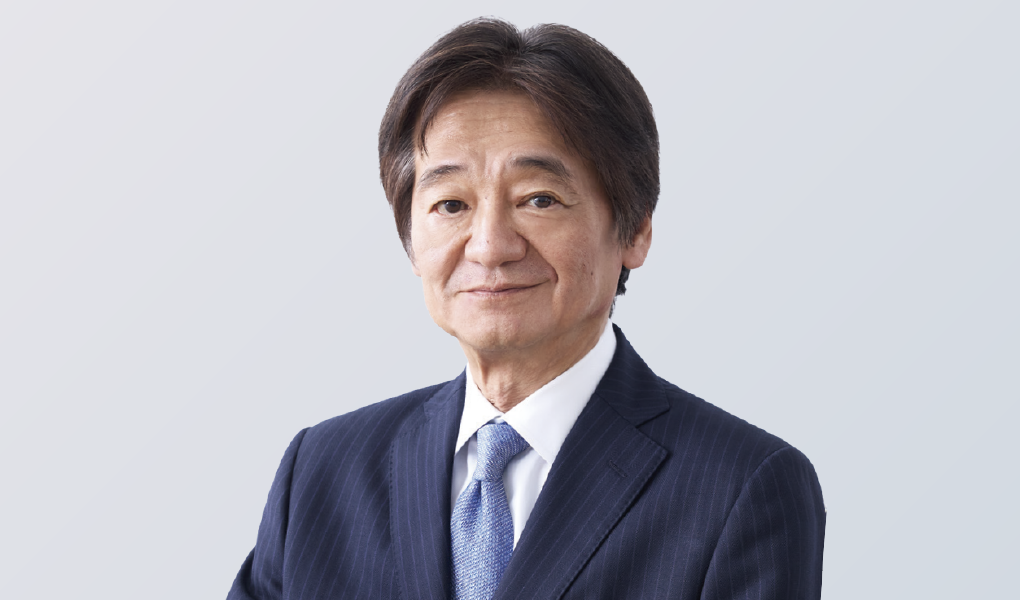
Hiroyuki Hamada
FY2025 was the second year of the artience2027 Medium- term Management Plan. It was a year in which it was necessary to redesign our business portfolio management.
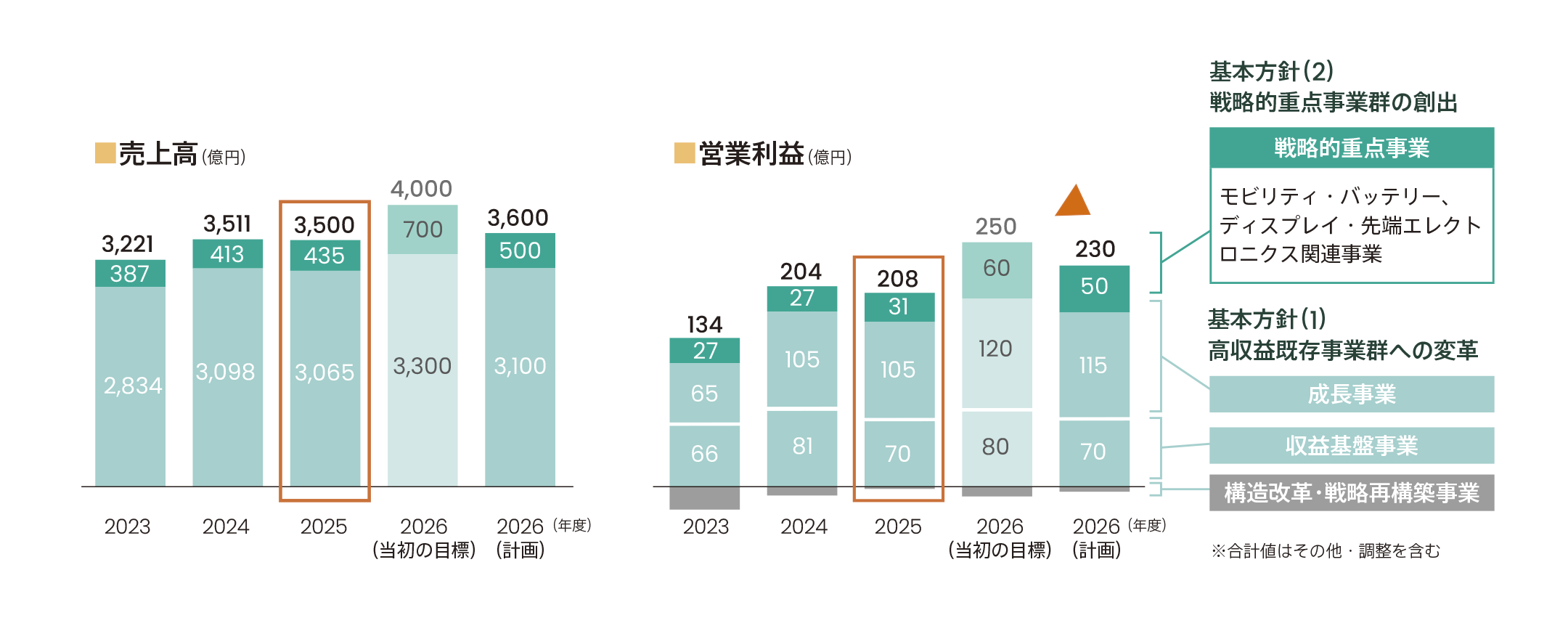
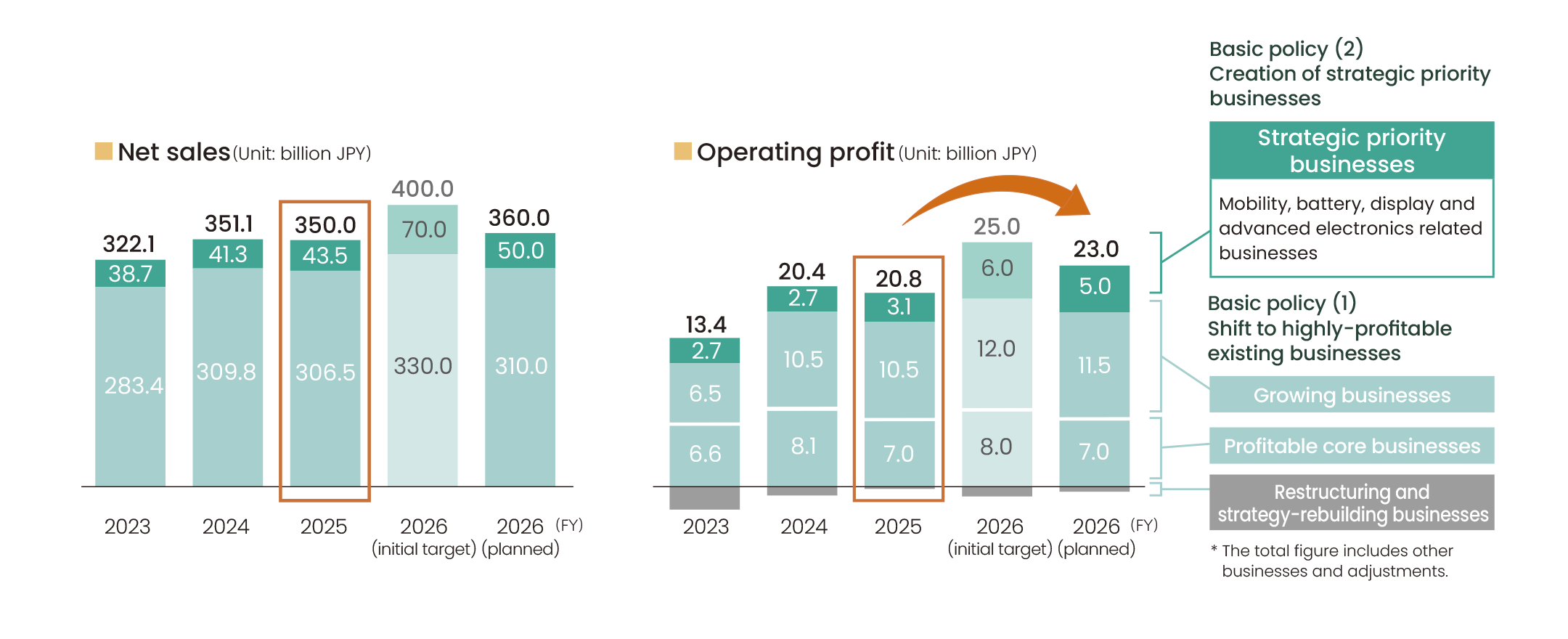
We made smooth progress on our first basic policy, shift to highly profitable existing businesses. I feel that we achieved strong results in terms of the qualitative improvement of our portfolio. Overseas sales of liquid inks and pressure sensitive adhesives for displays jumped sharply. This helped us reach a new high operating profit of 20.8 billion JPY.
On the other hand, regarding the second basic policy, the creation of strategic priority businesses, a major delay occurred in the CNT dispersions for lithium-ion batteries (LiBs) business, which we had defined as a growth pillar. A series of automobile manufacturers reconsidered their EV investments. Changes in external conditions have had a significant impact. As a consequence, we posted a huge impairment loss related to equipment in North America that is unlikely to operate in the foreseeable future.
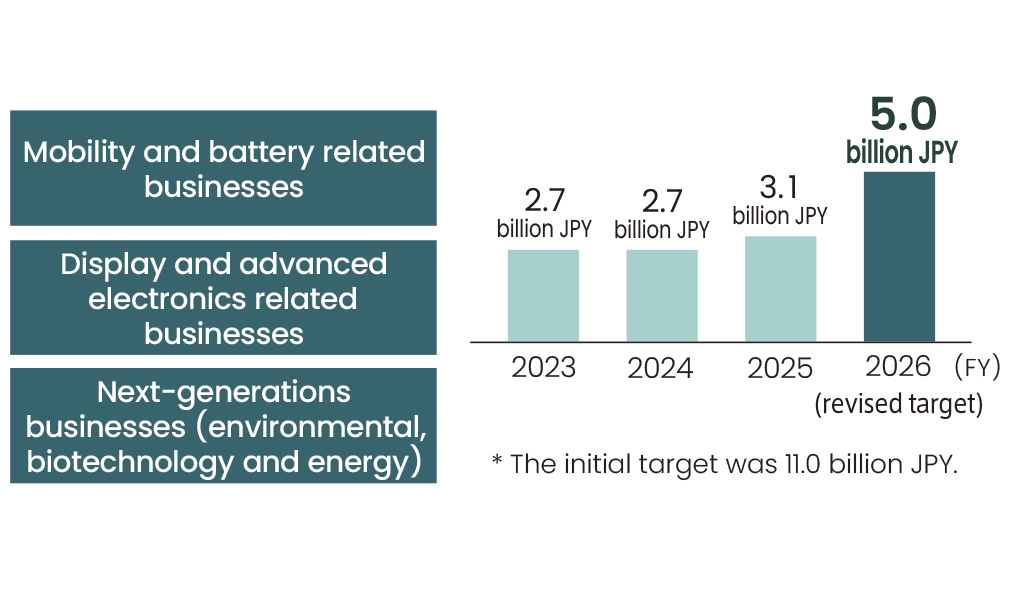
Since the preconditions have changed, we must review our strategies with a calm mind. For growth, we are shifting our focus to how we should cultivate the display and advanced electronics related businesses as the next pillar of our business.
FY2026 is the year for completing artience2027. We have already achieved the initial target of 14 billion JPY in operating profit regarding highly profitable existing businesses. We set a new target of 18 billion JPY in February 2026. The groupwide operating profit target for FY2026 is 23 billion JPY. Our stance of pursuing the business portfolio transformation and continuing to proactively invest in growth areas in line with our enterprising policy will not change throughout the period of the current medium- term management plan.
Under artience2030, the next Medium-term Management Plan, we will continue to sow seeds and create a blueprint for steady growth.
Shift to highly-profitable existing businesses
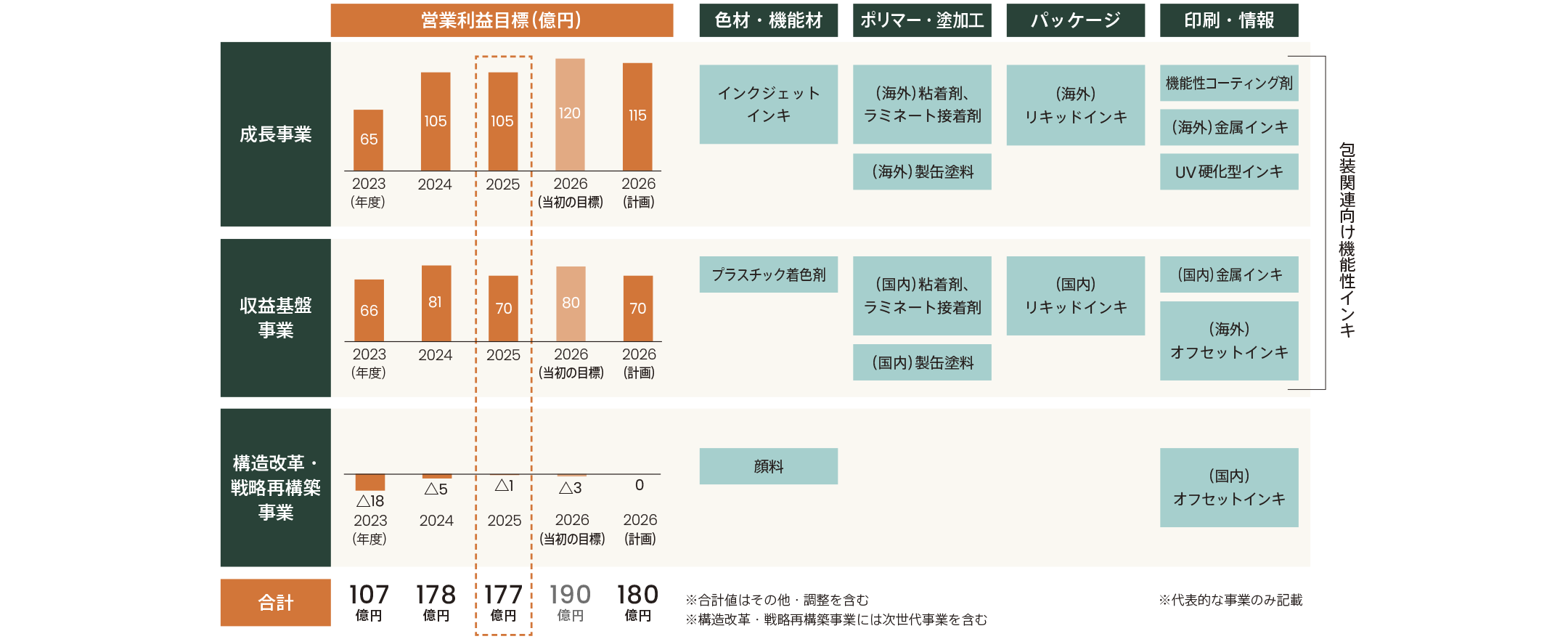
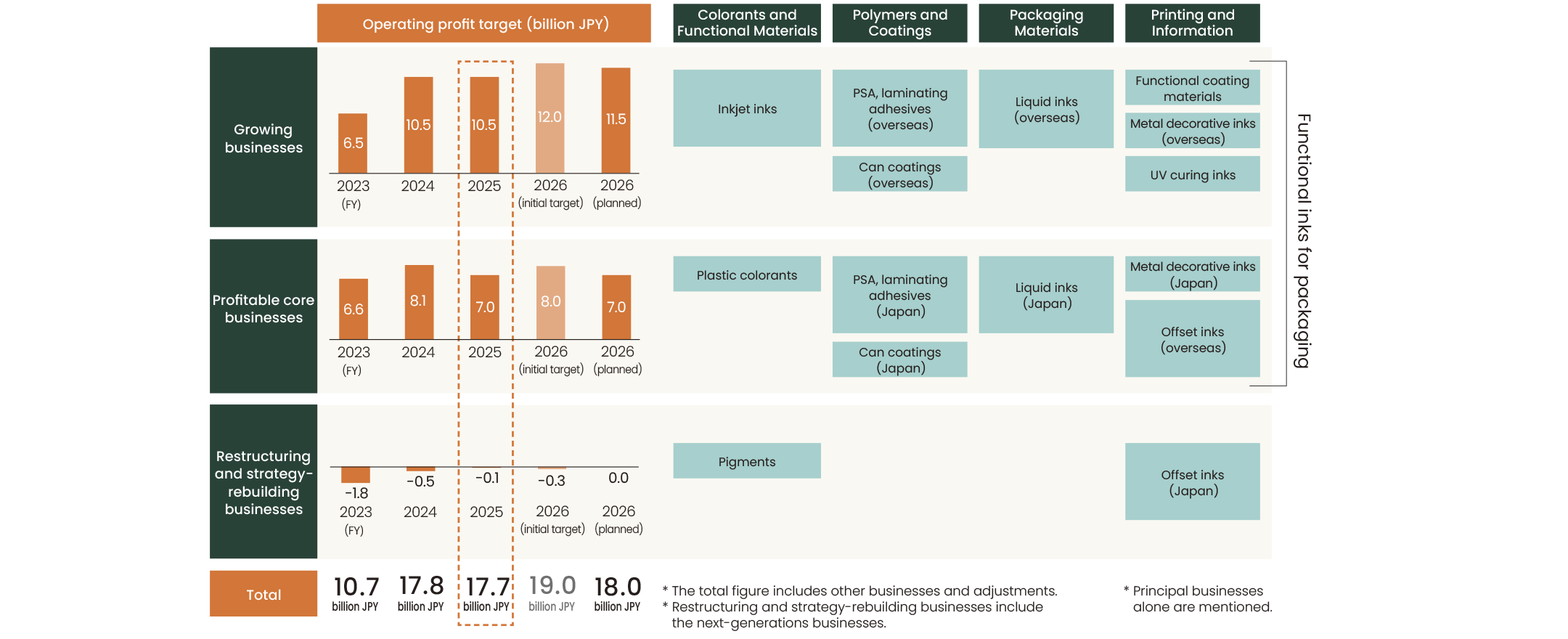
Many of our highly profitable existing businesses are of the highest class in terms of competitiveness in Japan. They are our revenue base. They are classified into three types of business: growing businesses, profitable core businesses and restructuring and strategy-rebuilding businesses. The roles of these businesses are clearly defined.
For example, liquid inks, which drive the Packaging Materials Business, is categorized as a growing business outside Japan, and as a profitable core business in Japan. In this business, we first achieved a large market share in Japan. Packaging for food and daily necessities ultimately ends up in the hands of consumers, and growth is limited in markets where the population has peaked. Our strengths in the technologies and knowledge that we have cultivated will be utilized to increase profits in overseas markets where demographic dividends are anticipated and some earnings will be allocated to our next investments to support our corporate growth. This is the role that growing businesses have to play.
We already operate businesses in 24 countries and regions, including India, Southeast Asia, China and Turkey. Our extensive network of bases enables us to respond flexibly to different markets. There are quite a few cases where new businesses are created when a customer launches a new business overseas. Our overseas operations are already responsible for at least 60% of the Group's total profit. I believe that this trend will continue.
Profitable core businesses in Japan are also important as they stably generate profits. We are keenly aware that the expertise we have developed in Japan drives our overseas expansion. We will more actively invest in Japan in FY2026. One example of these efforts is an approx. 4 billion JPY capital investment at the Saitama Factory, which manufactures inks and materials in the Packaging Materials Business. We attach importance to improving the working environment as well as streamlining and the reduction of labor, as the labor shortage is worsening. We will build a smart factory that people will want to work at.
In FY2025, we achieved positive results in the restructuring and strategy-rebuilding businesses category, too, by revising prices and increasing added value. The profitability of the pigments business increased considerably. Offset inks also turned profitable in Japan. This is a good example of the structural reforms to achieve profitability even amid the contraction of the market.
Trends in operating profit of strategic priority businesses
Creation of strategic priority businesses
Strategic priority businesses constitute a domain for developing new pillars for future growth. The artience2027 plan began amid the global shift to EVs. We initially expected that the CNT dispersions for LiBs business would make a big difference to the entire portfolio. However, its performance has not been as forecast, mainly due to changes in EV policies in the United States after the change of administration and delays in the construction of infrastructure.
However, this does not mean that the shift to EVs has ended. We will expand target markets and product ranges to prepare to seize opportunities when the EV market expands again. In addition to our mainstay products for ternary battery cathode materials, we are developing materials for lithium manganese iron phosphate (LMFP) batteries and anode materials and researching all-solid-state batteries. We are also looking to hugely expand applications for our products from the automotive industry to the fields of backup power sources for data centers and consumer devices.
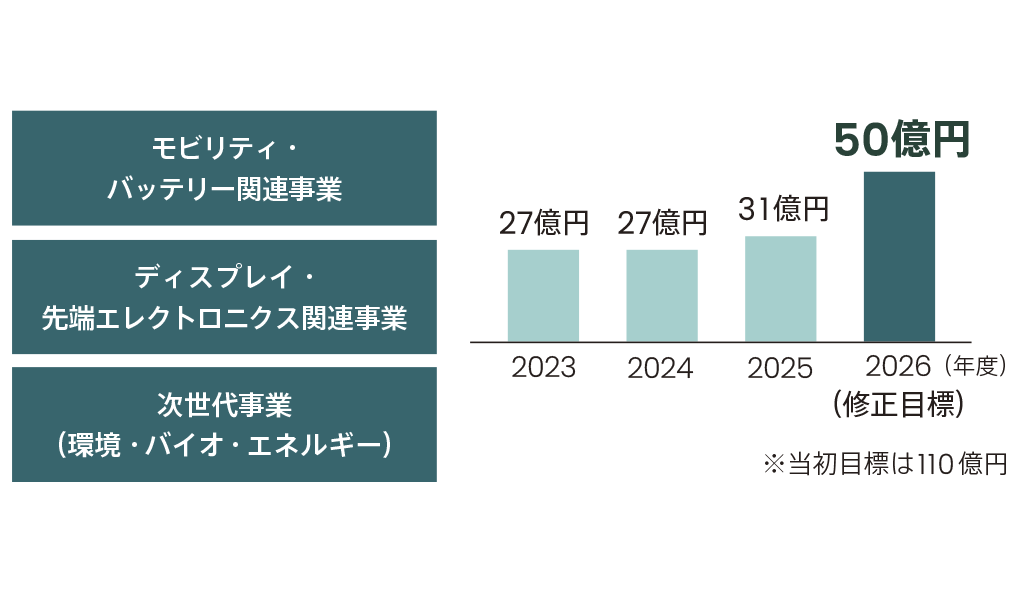
Another priority area compensating for the delays in CNT dispersions is the display and advanced electronics related businesses. We are making capital investments in a factory in Jiangmen, China to increase its optical pressure sensitive adhesive production capacity, as demand is high. In this area, a cycle has been established in which products developed in Japan are produced in China and provided to local customers. Business models like this that are premised on global operations have taken root, and they include cross-border collaboration in sales activities within the East Asia region and different bases engaging in complementary production.
On the other hand, color filter materials, which are mainly for the Chinese and Taiwanese markets, were affected by Chinese competition in FY2025. To address this competition, we established a joint venture with China- based Shenzhen RongDa Photosensitive Science & Technology Co., Ltd. to construct a structure for selling locally manufactured products.
In the domain of advanced electronics, we are accelerating our development of materials for smartphone components, data center applications and other products for growing markets.
To ensure that we capture business opportunities in promising areas, we have established a task force of about 20 people. I participate in its activities regularly. Some projects are already in the test marketing phase. We will step up our efforts with a view toward the next medium-term management plan. We possess unique materials such as polymer resins for semiconductors. We will expand the number of applications they have and the number of fields they are used in, including niche markets, through the development of products in multi-model projects to enable seedlings of new businesses to grow.
Trends in operating profit of strategic priority businesses
Trends in operating profit of strategic priority businesses
Status of CNT dispersions for LiBs at individual bases (as of March 2026)
|
Europe |
|
|---|---|
|
North America |
|
|
China |
|
|
Japan |
|
Reform of business foundation
We cultivate new businesses while improving the earning capabilities of existing businesses. These two endeavors are supported by our third basic policy, the reform of our business foundation.
For example, we are accelerating groupwide purchases of raw materials that account for 60% or more of our net sales. We have constructed a system in which our Singapore base acts as a hub for understanding demand in different regions to procure materials under more favorable conditions. The purchasing department cannot do this alone. The R&D and manufacturing departments have to cooperate in this initiative.
Digital transformation (DX) is also a key issue specified in our materiality. We actively encourage the use of generative AI, and we have constructed a system enabling people to use it in a closed internal environment. We will use it to share and analyze technical information for patent surveys and other tasks.
All of these initiatives depend entirely on people. We are working to increase their motivation by revising the evaluation system so that we appreciate people with proactive attitudes and by organizing opportunities for the president and employees to talk directly.
Now that approximately 5,000 of the nearly 8,000 people in the Group work outside Japan, developing overseas personnel is extremely important. In FY2025, we invited mid-career managers based overseas to Japan for training. We will continue these initiatives to improve their understanding of and engagement in the artience Group. Our recent investment in the streamlining of operations and the enhancement of worker-friendliness at the Saitama Factory was done with an eye toward the sharing of the know-how gained there with the rest of the Group.
Toward our long-term vision
The core of our growth story looking toward the next medium-term management plan lies entirely in how we build add-ons through strategic priority businesses on top of the solid platform established by our existing businesses. chieving our ROE target of 10% or more under the next medium-term management plan requires taking on challenges that go far beyond business-as-usual. Instead of relying solely on operational efforts, we will make bold management decisions and strategic investments to reach a higher level.
Another thing we focus on is our organizational culture. Our corporate philosophy is “people-oriented management.” We have a people-friendly corporate culture. Ideally, we want to capitalize on this advantage to ensure that every employee is aware of their roles and acts independently, and we work to unite the whole Group organically. We hope they will actively discuss issues in different places within the Group to survive this age of drastic change. It is important that they discuss issues on equal terms, regardless of their position, and that they act based on agreement.
When I talk with young and mid-career staff, I realize that they have strong ideas and that we have excellent personnel. One significant role that the management team plays is creating an organization that enables employees to fully display their potential. I am sure that these efforts will create a new artience that will support the Group's operations over the next ten years.
Management Plan artience2027/2030 "GROWTH"
Share


