
Medium-Term Management Plan artience2027 | Integrated Report 2026 Financial Strategy: Accelerating the improvement of capital efficiency and investments for growth while firmly maintaining financial discipline
Published on June 30, 2026
This page has been translated using AI.
Progress of the artience2027 Medium-term Management Plan
Takeshi Arimura
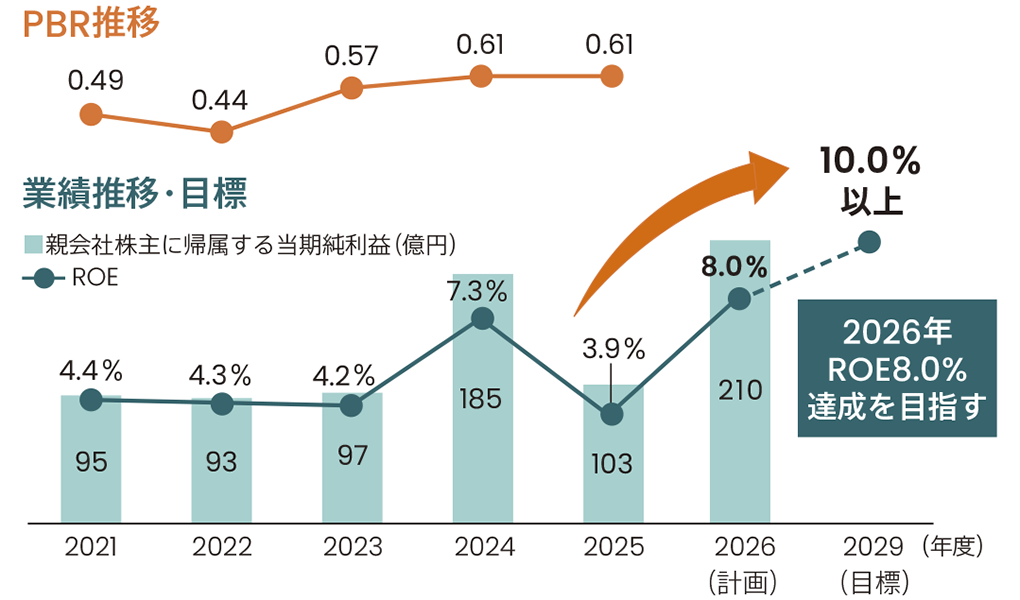
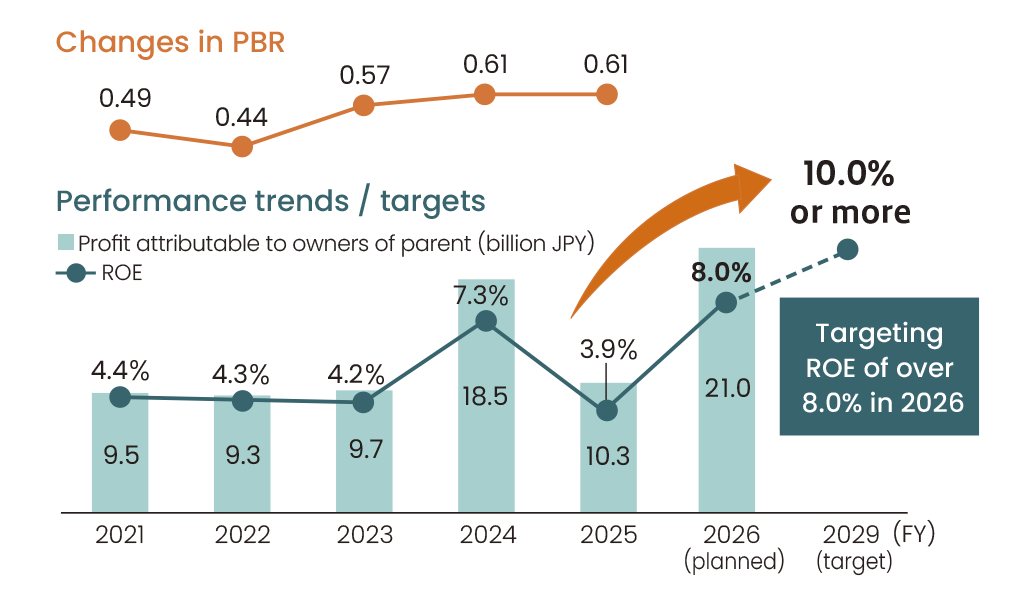
In FY2025, we endeavored to reconstruct the foundation for achieving GROWTH amid a dramatically changing environment. We posted an impairment loss in the business of CNT dispersions because of the slowdown of the EV market, and it significantly impacted our quantitative results. Although operating profit hit a new high, profit attributable to owners of parent fell and ROE stood at a low 3.9% because of this extraordinary factor. On the other hand, excluding the impact of that extraordinary factor, our profitability improved steadily. We forecast that our financial results will continue to improve in FY2026.
ROE in particular is such a key indicator that management is committed to achieving the 8% target set in the artience2027 Medium-term Management Plan. We will combine our business portfolio transformation, whose goal is mainly to increase operating profit, and capital policies, including the systematic sale of cross-shareholdings and the increase in shareholder returns, in a steady effort to reach that 8% target.
Currently, our PBR is below 1. My understanding is that this is due to our failing to achieve the ROE target on a real basis, and that it does not reflect our future growth potential. We must communicate our strategies and progress in detail through investor relations activities to increase investors' expectations. We will incorporate investor feedback into specific measures and management plans.
We are in the middle of a major transition from a deflationary macroeconomic environment to an inflationary one. From a business perspective, it is now easier to incorporate cost increases into prices. On the other hand, interest rates increasing in the future is inevitable. In view of this, we worked to reduce interest-bearing debt and strengthen our financial position in FY2025.
Regarding capital efficiency, we manage return on invested capital (ROIC) on a groupwide basis while separate operating organizations use the cash conversion cycle (CCC) as a principal indicator. We are making progress in our efforts to reduce inventories mainly in Japan, although there is variation from department to department. The awareness of our workers is undoubtedly changing. I believe that workers proactively engaging in improvement activities without waiting for instructions from supervisors will increase the strength of the Group in the future.
- ROE fell temporarily under the impact of the impairment losses recorded in 2025.
- In 2026, we aim to achieve the ROE target of over 8.0% by increasing profit. We will achieve an ROE that exceeds the cost of equity (approximately 8%) to increase our PBR.
|
Business portfolio transformation |
|
|---|---|
|
Increase capital efficiency |
|
|
Capital policies |
|
|
Efforts to lower capital costs |
|
- Up to 4.5 million shares or 10.0 billion JPY (Purchase period: May 12, 2025 to May 11, 2026)
Changes in PBR and Performance Trends & Targets
Reconsidering our investment policies and optimizing cash allocation
In FY2025, we established the Investment Policy Discussion Task Force and the Balance Sheet Reform Task Force. They are both groupwide initiatives that discuss involvement policy and balance sheet reform, respectively. Specifically, the Investment Policy Review Task Force has organized and proposed specific policies to invest to accelerate growth and how to maintain financial and investment discipline.
Our past investment decisions were based on whether the amount was roughly within the limit of depreciation. This approach led to the prioritization of investments for growth, and it restricted investments in the maintenance and replacement of equipment. At Japanese sites, aging buildings and equipment had to be used for a long time.
In light of these circumstances, we have changed our investment policy. First, we have introduced a new system regarding investments for growth. Accordingly, we will implement necessary investment projects flexibly without being constrained by the conventional limit of depreciation. With an eye toward the decrease of the working population in the future, we will allocate sufficient resources to investments in automation, labor- saving, and working environments. Our focus is on clearly prioritizing investments rather than uniformly investing in all businesses. While keeping ROIC at a certain level or higher, we will concentrate on investments that will increase our competitiveness in areas defined as growing businesses or profitable core businesses.
One example of our cash allocation decisions is that we decided to cancel a portion of an investment scheduled in the business of CNT dispersions in consideration of the changes in market conditions. The funds that would have been used for the canceled portion of the investment were reallocated to growth investments in other areas and investments in maintenance and streamlining. We plan to front-load growth investments when the timing is right, even in areas in which we expect to invest during the period of the next medium-term management plan, artience2030. In the current fiscal year, we are accelerating the increase of our production capacity in the liquid inks business in India and the pressure sensitive adhesives business in China.
In the category of investments for maintenance and streamlining, we decided to invest in the liquid inks business at the Saitama Factory. In this business, we are improving profitability through integrated manufacturing and sales operations, such as product line consolidation, and we are implementing other cost-cutting initiatives. We will address labor shortage and streamline operations by means of automation and replacement of equipment.
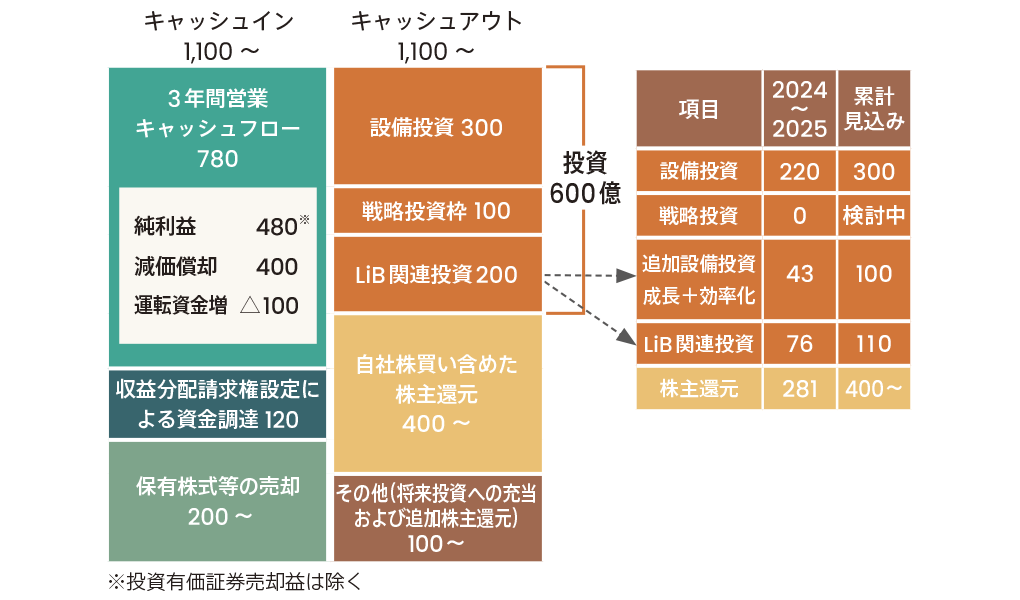
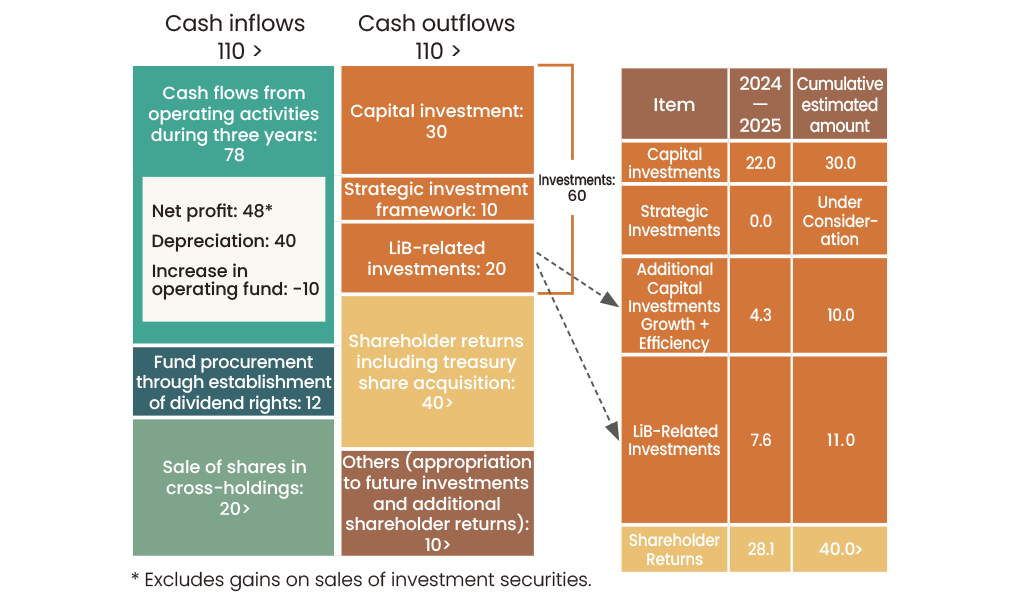
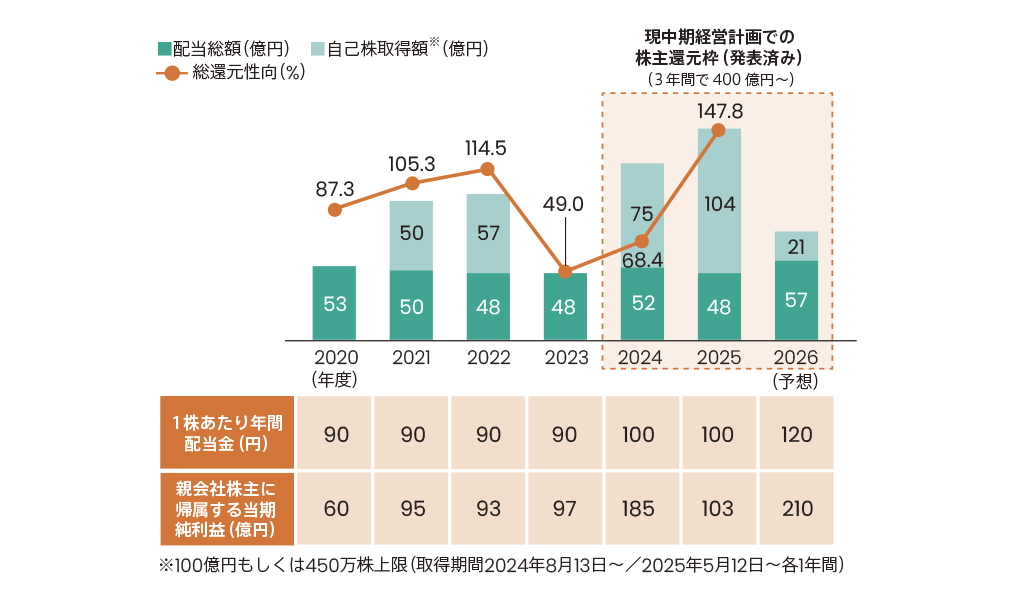
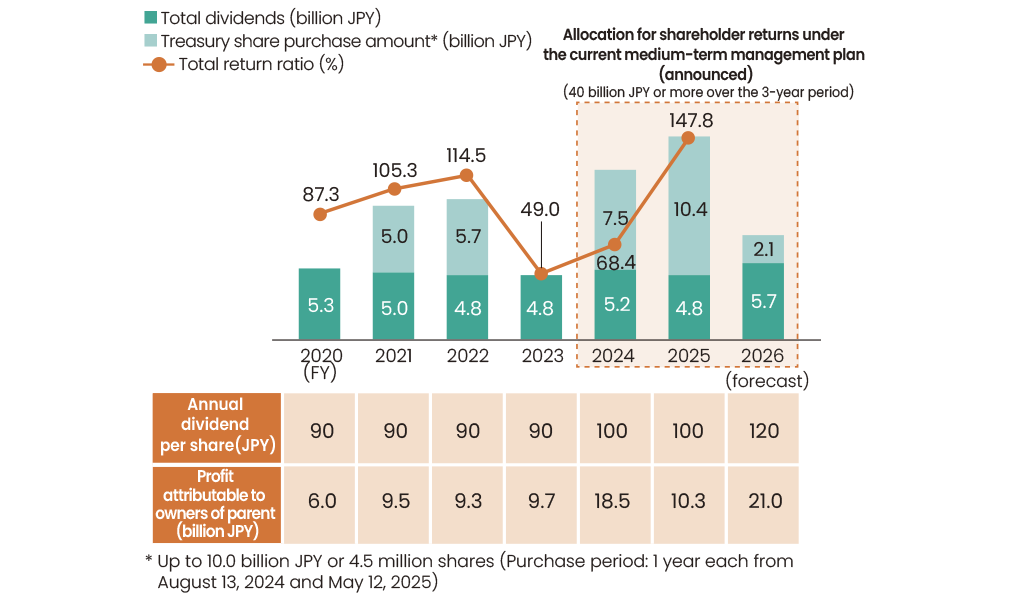
Regarding shareholder returns, we already achieved our total payout ratio target of at least 50% that was set in artience2027. We have already allocated more than 35 billion JPY of the anticipated 40 billion JPY in total shareholder returns over the three-year period. We have already announced that dividends will increase in FY2026. We are studying appropriate methods for returning the remainder.
Capital policy in the 3 years of the medium-term management plan and progress with cash flow allocation (Unit: billion JPY)
Shareholder returns
Improving the precision of investment decisions to ensure accountability
The greatest key to accomplishing the artience2027/ 2030 "GROWTH” management plan is increasing the profit margin. It is of course important to increase the profit margins of individual businesses, but it is also necessary to boldly transform the business portfolio to the one with higher capital efficiency and profit margins from a broader point of view. I feel that we are assessed based on our real ability to utilize our stable financial base to increase our corporate value. In the current phase in which the yen is depreciating and interest rates are rising, it is vital that we retain our A financial rating. It is directly linked to the cost of procuring funds. We will continue to firmly maintain this policy.
It is essential that we proactively invest in growth, but, from the Finance & Accounting Department's perspective, it is also essential that we maintain investment discipline. Given our posting of a large impairment loss in FY2025, we will more closely examine preconditions for investment decisions and review them as appropriate after we invest. This does not however mean that we will be overly conservative. We will assess the appropriateness of investments calmly and support truly valuable investments while putting the brakes on projects that do not meet our criteria. I believe that distinguishing between the two is my core role as the officer responsible for finance.
I always make decisions based on explainability. I continually question if it is possible to explain the appropriateness of each measure or proposal to people inside and outside the Group, and check whether each decision can be explained with a clear, logical rationale. I seek financial strategies that can be understood through dialogue, even when people have different views, to achieve accountability in its true sense.
Management Plan artience2027/2030 "GROWTH"
Share


