
Epoxy resin for CFRP – Matrix resin that achieves both high heat resistance and low modulus
This website uses automated machine translation. Please note that translations may not be fully accurate and may differ from the original Japanese text.
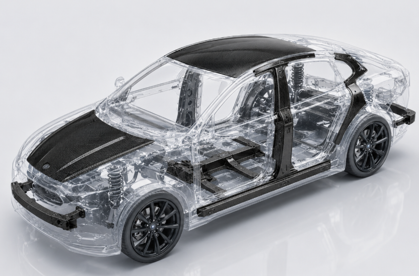
Applications are expected in fields requiring harsh environments, such as aerospace, next-generation automobiles, and high-performance sports equipment.
Product Features – Resin that balances "high heat resistance" and "low modulus"
In CFRP development and molding, conventional CFRP-impregnated resins tended to increase crosslinking density, have high elastic modulus, and become rigid and brittle, as heat resistance increases. Therefore, cracks and delamination caused by differences in thermal expansion and structural distortion have become major challenges in high-temperature environments such as engine peripheral parts and aerospace applications, as well as under pressure conditions such as pressure-resistant vessels.
On the other hand, methods of adding modifiers such as rubber particles to improve flexibility led to reduced heat resistance and significant deterioration of impregnation due to increased viscosity, making it difficult to develop resins that combine the required "high heat resistance" and "low modulus."
However, the resin we developed has solved this trade-off.
Nano-level structural control unlocks the full potential of epoxy resin
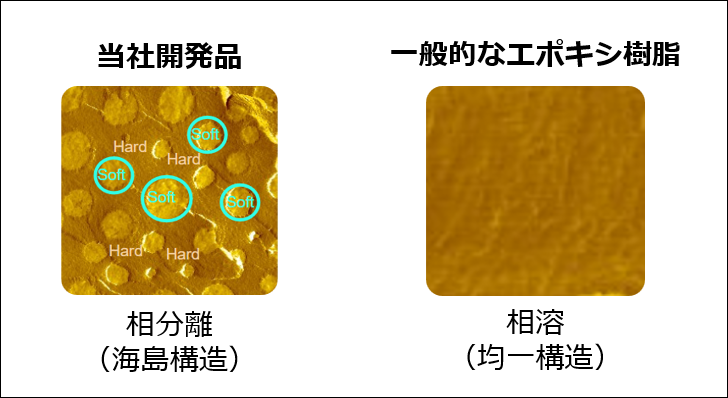
TOYOCHEM has succeeded in precisely controlling nano-level phase separation formation during the curing process using proprietary molecular design technology.
By introducing flexible segments within a robust epoxy cross-linked network, we achieved dramatic flexibility while maintaining the high heat resistance and strength of epoxy resin.
This coexistence of opposing physical properties enables the design of lightweight, high-strength, and high-toughness CFRP structural members.
Excellent stress relief
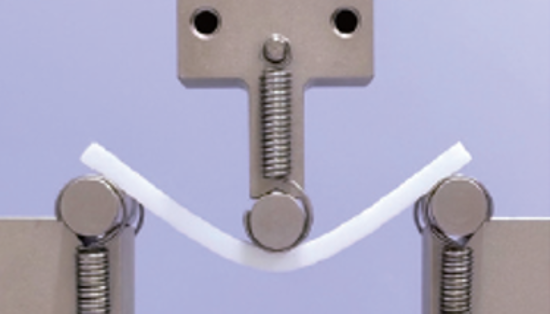
By flexing the resin, it achieves high stress relief, preventing interface delamination and cracks caused by impact and expansion. Even in harsh environments such as automotive reinforced parts requiring durability comparable to metals and next-generation fuel tanks, it demonstrates excellent fracture toughness and thermal cycle durability, dramatically improving long-term reliability.
Excellent processability for compatibility with diverse molding processes
This product is a low-viscosity liquid resin with high impregnation and adhesion to fibers, suppressing void formation.
It can be adapted to various molding processes such as RTM, VaRTM, and prepreg applications.
Additionally, viscosity and curing conditions can be adjusted to match productivity.
Physical property data supporting high Tg (heat resistance) and high elongation
The resin we developed maintains a high Tg (heat resistance) equivalent to typical epoxy resins, as shown in the test results below, while achieving both low elastic modulus and high elongation at a high level.
| representative value | Evaluation/Credits | Our product | Common epoxy resins |
| modulus of elasticity | Tensile/GPa | 0.8~1.5 | > 3.0 |
| Glass transition temperature (Tg) | Tensile/°C | 140 | 150 |
| Strength | Three-point bending / MPa | > 50 | 60 ~ 80 |
| Elongation | Tensile/% | 10 ~ 20 | < 3 |
| Mixed viscosity @ 80°C | Pa・S | About 0.1 | - |
| Standard curing temperature | - | 80℃ ~ 120℃ | - |
- The above data is representative and not guaranteed.
High heat resistance (high Tg)
Achieves a glass transition temperature (Tg) as high as 140°C. Maintains the inherent high durability of epoxy resin, suppresses degradation in physical properties even in high-temperature environments, and ensures long-term product reliability.
Flexible physical properties (low modulus)
With a low modulus of elasticity below 1.0 GPa and a highly flexible (high-elongation) design, it alleviates local stress applied to CFRP molded bodies. It provides excellent toughness and impact resistance, reducing the risk of product damage.
From next-generation mobility to sports Examples of applications for CFRP epoxy resin
With its low modulus and high elongation, it is suitable for applications requiring excellent fracture toughness, impact resistance, and fatigue resistance, and has also been proven in automotive applications where advanced durability is required. Not only in carbon fiber (CFRP) but also in glass fiber (GFRP) matrix resins, it contributes to suppressing interface delamination and improving long-term reliability, demonstrating high compatibility.
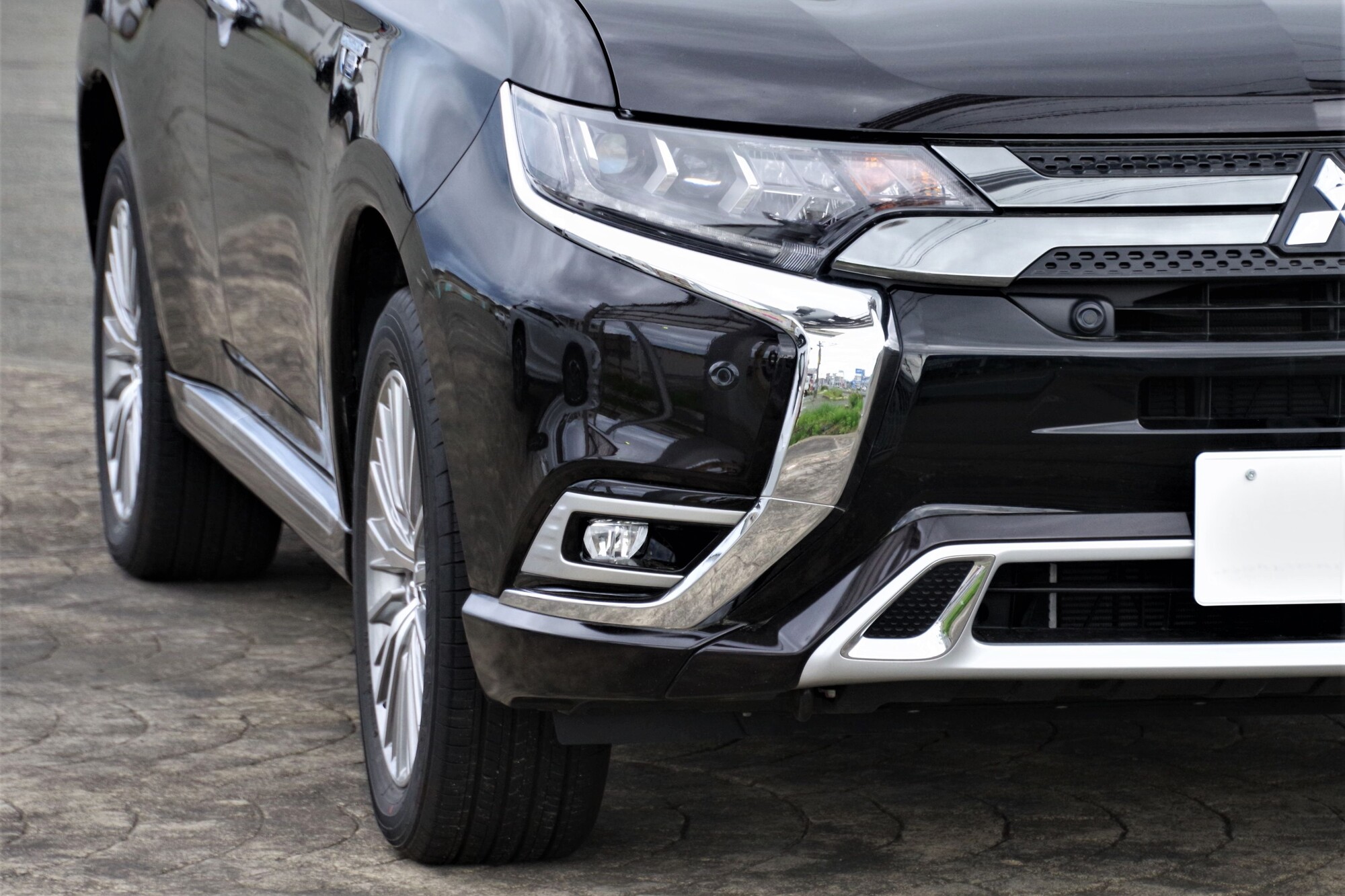
Next-Generation Vehicles & Mobility
(Body panels, pressure-resistant containers, tanks, etc.)
Required Features
Resistance to high-temperature environments around the engine, and high fracture toughness against expansion and contraction caused by thermal cycling.
Why this product is the best choice
Achieves high Tg. The inherent high durability of epoxy resin prevents cracking and interface delamination even under harsh thermal cycles, improving long-term reliability.
Advantages of processing and processes
Thanks to its low-viscosity design, even in complex reinforcement shapes and large tank molding (such as RTM), the fibers are impregnated evenly to every corner.
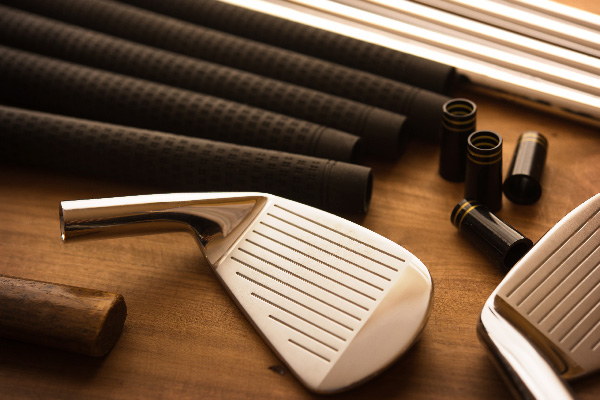
High-performance sports equipment (bicycle frames, rackets, rods, etc.)
Required Features
Excellent fatigue resistance and shock absorption to withstand strong impacts and repeated bending stresses during use.
Why this product is the best choice
Its unique nano-level structure control provides excellent flexibility and shock absorption, reducing the risk of damage.
Advantages of processing and processes
Adaptable to prepreg applications. We flexibly accommodate customization of viscosity and curing conditions to match your production equipment and cycle.
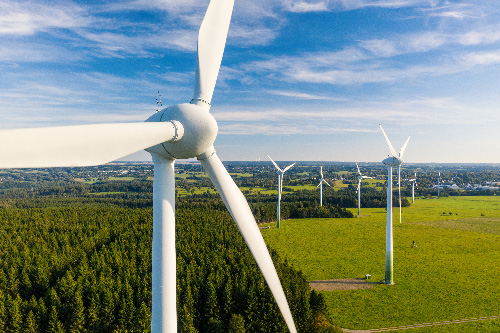
Industrial machinery and aerospace structural materials (robot arms, wind turbine blades, etc.)
Required Features
Maintaining structural strength and ensuring long-term reliability for large components, as well as improving manufacturing yield.
Why this product is the best choice
Provides excellent adhesion not only to carbon fiber but also to glass fiber (GFRP). It suppresses interlayer delamination even under prolonged stress loads.
Advantages of processing and processes
Thanks to excellent initial impregnation, it suppresses void (bubble) formation even in large VaRTM molding processes, achieving high-quality, stable molding.
Frequently Asked Questions about Epoxy Resin for CFRP
It is suitable for a wide range of molding processes, including RTM (resin injection molding), VaRTM (vacuum-assisted injection molding), and impregnation into prepreg (intermediate substrates). With low-viscosity design, it delivers high impregnation for complex shapes and large components.
It exhibits excellent adhesion and compatibility not only with carbon fiber but also with glass fiber. It is also ideal for high-performance applications such as electrical insulation materials and communication infrastructure components where GFRP is widely used.
Tg140°C high heat resistance design is possible. Maintains structure even in high-temperature environments such as around engines and power units, and its low-elasticity properties suppress delamination and cracking caused by thermal cycling (expansion and contraction), making it ideal for automotive components
Conventional high heat-resistant epoxy faced challenges such as hardness and fragility. However, our product achieves durability that overturns conventional epoxy expectations by combining the "adhesion and heat resistance" of epoxy with the same "adhesion and heat resistance" through nanostructure control while simultaneously providing rubber-like flexibility.
We can adjust optimal viscosity and curing conditions (temperature, time) according to your molding equipment and production cycle.
We can provide such services. After hearing about your target physical properties, we will propose the most suitable grade. Please feel free to contact us via the inquiry form.
Inquiries
TOYOCHEM CO., LTD. Packaging and Industrial Materials Sales Division Sales Department 1
TEL:03-3272-0940