
CO2 Absorption Materials (Initiatives for CCUS)
This website uses automated machine translation. Please note that translations may not be fully accurate and may differ from the original Japanese text.
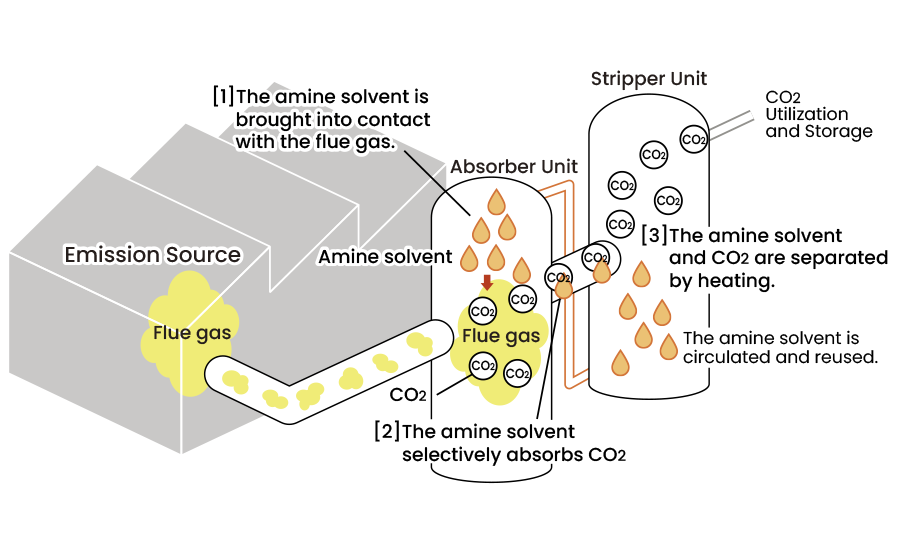
TOYOCOLOR, an artience Group company, is working on the development of various absorption materials that enable the efficient capture of large amounts of CO2 emitted from factories—such as steelworks and oil refineries—as well as CO2 from the atmosphere. Utilizing the material design and compounding technologies cultivated by the artience Group over many years of colorant synthesis and ink formulation, our developed products balance high absorption performance with stability. Through these products, we pursue material designs that contribute to reducing energy loads and optimizing processes. Anticipating applications across a wide range of fields, including power generation, chemicals, and industrial sectors, we provide solutions that support next-generation CCUS technology through two approaches: Chemical Absorption and Solid Adsorption.
Chemical Absorption Method: Amine Solvents
The chemical absorption method is a leading CO2 capture technology that selectively absorbs and separates CO2 from flue gas through a chemical reaction between an absorbent liquid and CO2. TOYOCOLOR is advancing the development of materials that offer an excellent balance between CO2 capture performance and regeneration thermal energy. Our focus centers on aqueous amine solvent solutions using only water as a solvent. Engineered for practical industrial application, our solutions combine high capture efficiency with long-term durability.
The chemical absorption method is a representative CO2 capture technology that selectively absorbs and separates CO2 in flue gas by utilizing chemical reactions between the absorption liquid and CO₂. Our company is developing materials that excel in balancing CO2 capture performance and renewable thermal energy, focusing on aqueous amine solvent solutions that use only water as a solvent. With a focus on practical process application, we offer solutions that combine efficiency and durability.
Features of Our Developed Products (Technical Advantages)
- Low-Viscosity Absorption Design
Achieves low viscosity through the optimal design of amines and solvents. This improves the circulation efficiency of the absorption solution within the capture equipment and reduces the load on liquid transfer pumps, contributing to stable equipment operation and reduced operational costs (power consumption). - Low-Temperature Desorption
By optimizing amine materials and reducing the specific heat of the absorption solution, we achieve a significantly lower temperature for the CO2 desorption process compared to conventional products. This drastically cuts thermal energy consumption and lowers operational costs. - Outstanding Volatility Suppression
By designing and selecting amines and solvents that are less likely to volatize at elevated temperatures, we minimize heat loss due to evaporation and temperature rise. This prevents unnecessary energy loss and enables the long-term, stable operation of the capture system.
- Non-hazardous materials response (Fire Service Act)
Capable of designing to meet the "non-hazardous" standards under Japan's Fire Service Act. With implementation, explosion-proof equipment is no longer required, and there are no restrictions on specified quantities, enabling reduced capital investment costs and flexible, safe operational management.
Performance Comparison Data
| Section | Company A (Water-based) |
TOYOCOLOR Product (Water-based) |
Our Developed Products (Solvent-based) |
Conditions |
|---|---|---|---|---|
| Viscosity | 3 mPa·s | <15 mPa·s | <35 mPa·s | E-type viscometer @ 40°C, during saturated CO2 absorption |
| Desorption Temperature | 120 ℃ | <100℃ | 80~90 ℃ | Recommended temperature |
| CO2 Recovery Energy | ~3.9 GJ/CO2t | ~3.0 GJ/CO2t | ~2.6 GJ/CO2t | Theoretical calculated value |
| Flash point | none | none | >130℃ * | Cleveland Open |
(Evaluated in-house at TOYOCOLOR)
- Solvent-based amine absorption solutions can also be redesigned to be "non-hazardous" by adjusting moisture content and other means.
CO2 Capture Energy Breakdown: Competitor vs. TOYOCOLOR Product
The amine solvents developed by TOYOCOLOR offer a high cyclic CO2 capacity, enabling a reduction in both sensible heat for heating and heat loss due to stripping steam. Compared to conventional products, our products significantly decrease energy consumption across the entire CO2 separation and capture process. For the future, we have set a target to cut CO2 capture energy consumption roughly in half, aiming for 1.8 GJ/t-CO2 or less.
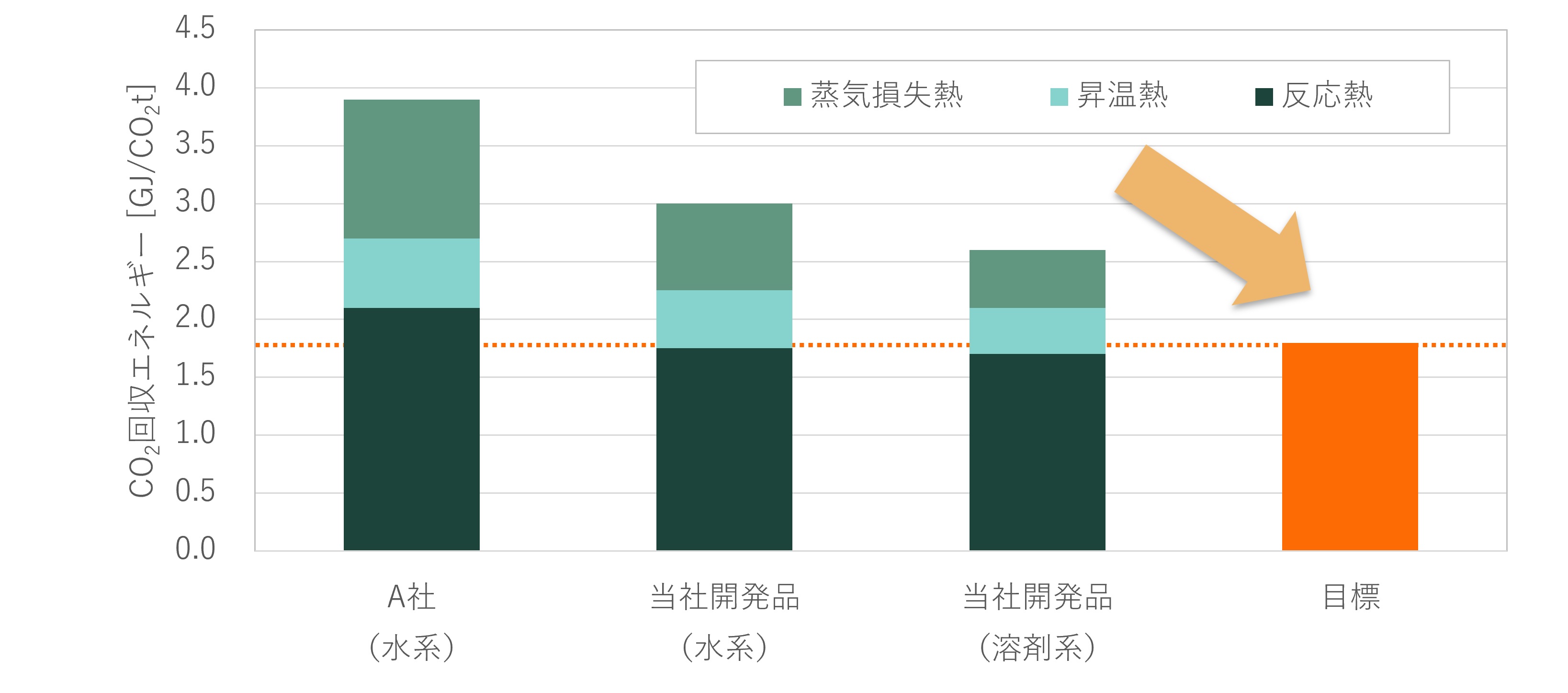
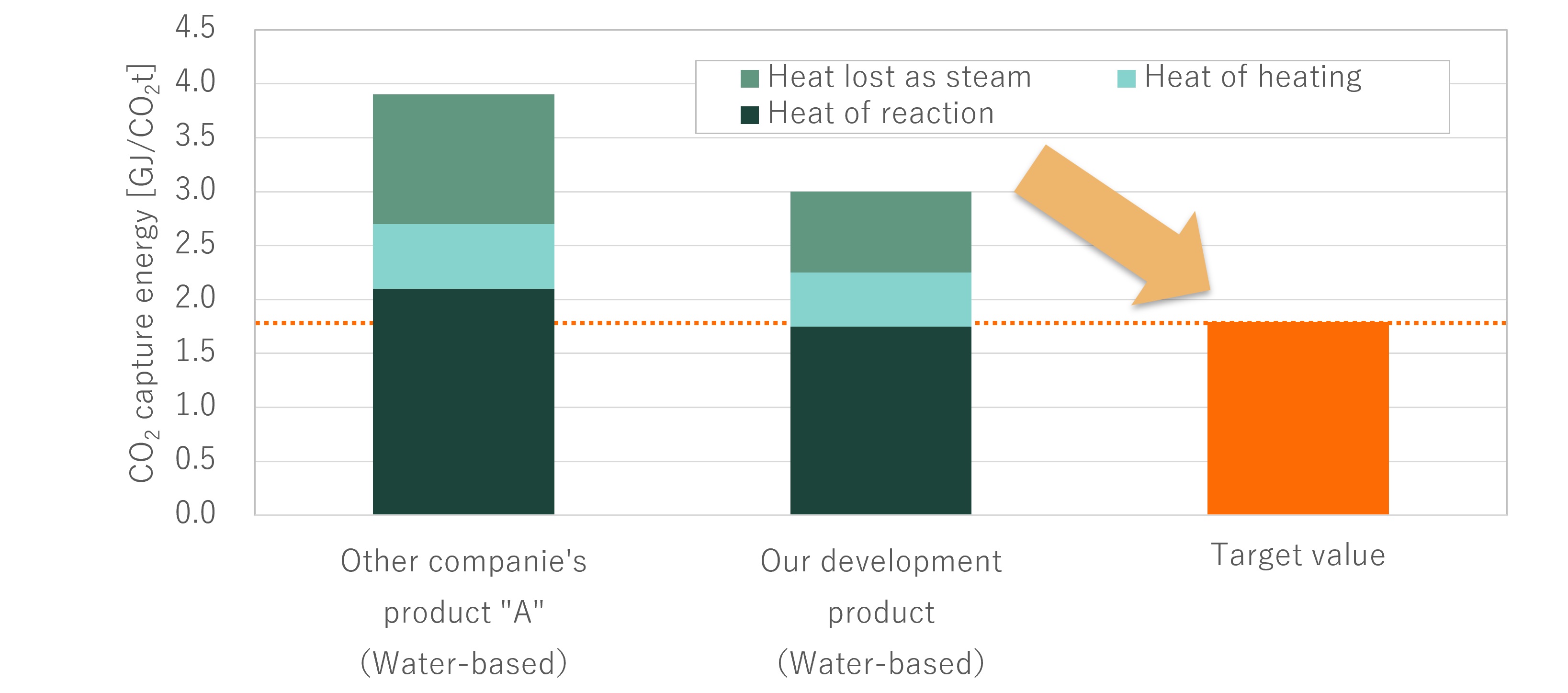
- Heat of reaction: The heat required for chemical reaction with CO2
Sensible heat: The heat required to heat the absorption liquid
Steam loss heat: The heat loss due to solvent evaporation
Our Strengths
Leveraging the material design and compounding technologies long cultivated by the artience group, TOYOCOLOR can select the optimal materials tailored to our customers’ specific CO2 capture equipment specifications and operating conditions. This allows us to accommodate a wide variety of parameters, including:
- Proprietary design of amine materials
- Selection of amine material types
- Optimization of solvent composition
- Viscosity adjustment
TOYOCOLOR will continue its development efforts to further reduce CO2 capture energy, contributing to the realization of a decarbonized society.
Solid Adsorption Method: Solid Adsorbents
The solid adsorption method is a process that chemically or physically captures CO2 on the surface of a solid adsorbent consisting of a porous support structure loaded with amines. Since it does not use liquids, it eliminates the need for latent heat of vaporization or significant sensible heat from water. This enables the desorption of CO2 from the adsorbent at low temperatures of 80°C or below, making it highly suitable for Direct Air Capture (DAC) and low-temperature exhaust gas applications.
Features of Our Developed Products (Technical Advantages)
- Low-Temperature Regeneration
While standard materials like polyethylenimine (PEI) require a desorption temperature of 100°C, our developed product can desorb CO2 at approximately 70°C. This directly contributes to reducing energy consumption during desorption. - Outstanding Durability (Heat Resistance and Oxidation Prevention)
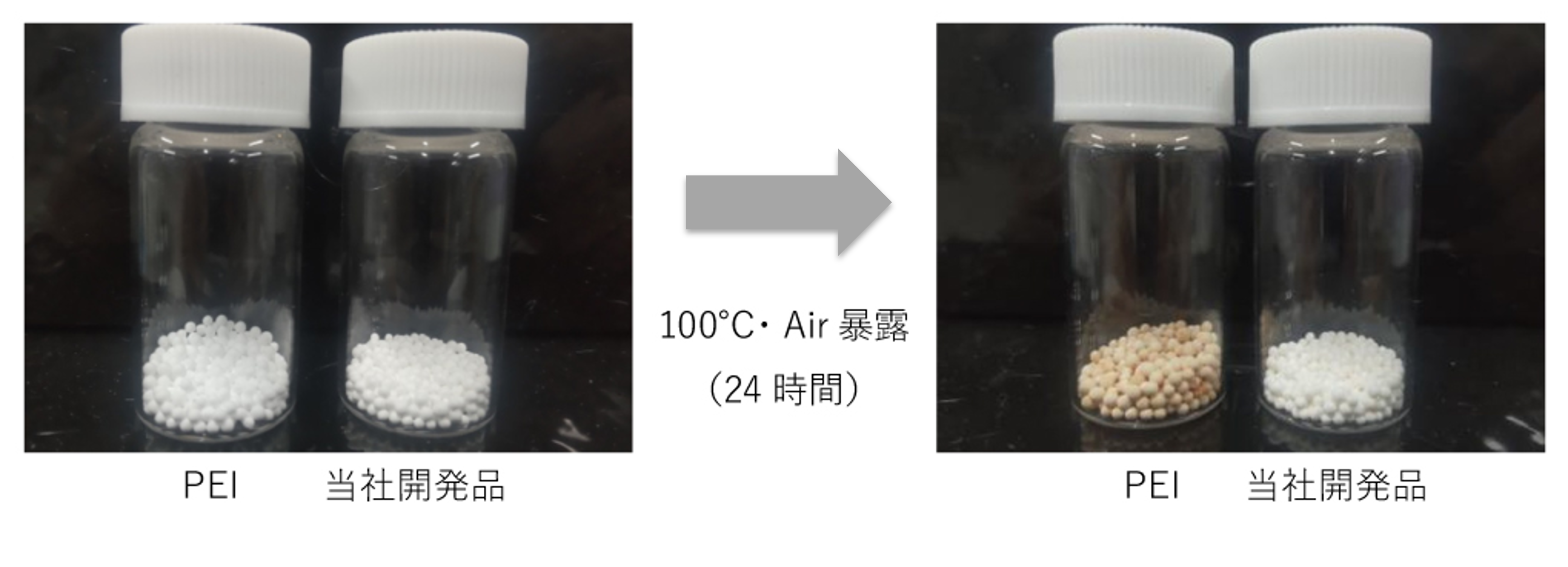
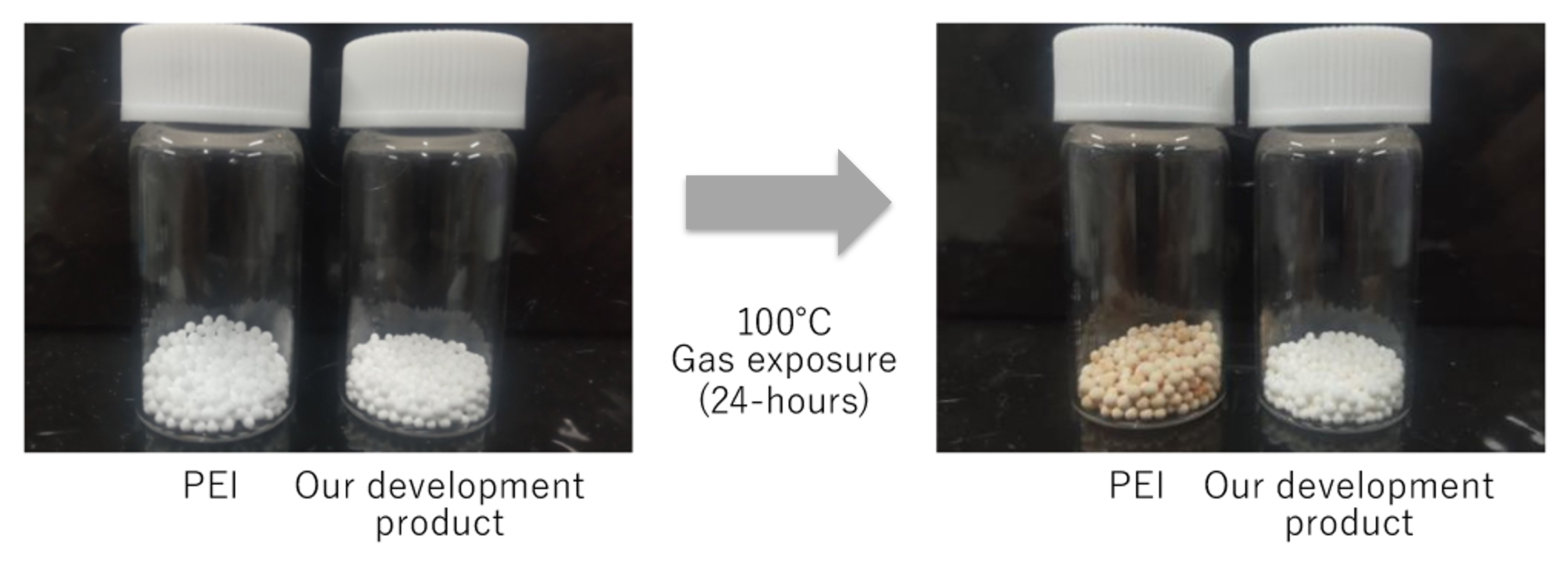
Our product demonstrates a performance retention rate after accelerated degradation testing that is more than twice that of PEI. This allows for long-term use and helps reduce running costs. - Compatible with Various Substrates
We can deliver optimal amine material designs and loading methods tailored to the specific type and surface characteristics of the substrate.
Compatible Substrates: Silica particles/powders, inorganic ceramic structures, Metal-Organic Frameworks (MOFs), etc.
Performance Comparison Data
| Section | PEI (Standard Product) |
TOYOCOLOR Product | Conditions |
|---|---|---|---|
| CO2 Adsorption Performance | STD | Equal to or lower than STD | CO2 concentration: 400 ppm, 25°C, during CO2 saturation adsorption |
| Desorption Temperature | 100 ℃ | 70 ℃ | Recommended temperature |
| Durability (Heat resistance and oxidation prevention) |
STD | 2x or more (Compared to PEI) |
After accelerated degradation test (100°C, 24 hours, air exposure) |
(Evaluated in-house at TOYOCOLOR)
Comparison before and after accelerated degradation testing
Our Strengths
Leveraging the proprietary material design technologies long-cultivated by the artience Group, we achieve optimal amine material designs and loading methods tailored to the specific types and surface characteristics of each substrate. This enables flexible customization to match our customers’ specific applications and substrate specifications.
Share


Inquiries
TOYOCOLOR CO., LTD. Advanced Materials Laboratory
TEL:+81-49-288-1506