
Corporate Governance
This website uses automated machine translation. Please note that translations may not be fully accurate and may differ from the original Japanese text.
- Basic approach
- Corporate governance system
- Complying with the Corporate Governance Code
- Dialogue with Shareholders and Investors
Basic approach
Enhancement of corporate governance through continuous reform is one of the pillars of our sustainability management. We will continue to continuously reform and verify management resources and risk management, and build and maintain effective corporate governance. In addition, we will flexibly adapt to changes in the business environment and strive for resilient corporate management that contributes to the sustainable growth of the Group.
The Board of Directors of artience Co., Ltd. (hereinafter referred to as the “Company”) has established the following basic corporate governance policies to contribute to the sustained growth of the Company and its subsidiaries and affiliates (hereinafter referred to as the “Group” collectively) and the improvement of their corporate values in the medium and long term.
Chapter 1 General Provisions
Article 1: Basic Ideas Concerning Corporate Governance
The Company shall continue to improve corporate governance based on the following approaches from the perspectives of sustaining the growth of the Group and enhancing its value in the medium and long term.
- Respect the rights of shareholders and make efforts to guarantee their substantial equality.
- Attempt appropriate collaborations with various stakeholders.
- Guarantee transparency by disclosing corporate information (including nonfinancial information) appropriately.
- The Board of Directors acknowledges its fiduciary responsibility to shareholders, and works to maintain and improve its functions.
- Hold constructive dialogues with shareholders that have investment policies in agreement with medium- and long-term shareholder returns.
Chapter 2: Guarantee of the Rights and Equality of Shareholders
Article 2: General Meetings of Shareholders
The Company shall issue the convocation notice for an Ordinary General Meeting of Shareholders at least three (3) weeks before the date of the Meeting so that shareholders can sufficiently examine the items on the agenda of the Meeting and exercise their voting rights appropriately. At the same time, the Company shall disclose the relevant convocation notice through the Timely Disclosure Network (TDnet) of the Tokyo Stock Exchange and on its official website.
2 The Company shall make efforts to prepare conditions for the exercise of voting rights by shareholders, including the practical use of a platform for the electronic exercise of voting rights and translation into English of the reference material for the notice of the annual general meeting of shareholders.
Article 3: Guarantee of the Rights and Equality of Shareholders
The Company shall attempt to make appropriate responses for substantially guaranteeing the rights of shareholders and work to prepare conditions for the exercise of their rights. In addition, the Company shall give consideration to the substantial equality of shareholders, including minority shareholders and foreign shareholders.
Article 4: Shareholdings Based on Policies
As part of its management strategy, including business alliances, maintaining and strengthening business relationships, and stable procurement of raw materials, the Company shall hold shares in companies that it deems necessary, as a matter of policy. Every year, the Board of Directors shall examine the economic rationality of each individual shareholding from a medium- to long-term perspective, and sell those shares that have lost their significance as shareholdings.
2 As a result of the verification set forth in the preceding paragraph, even if it is determined that there is significance in holding a stock, if it will contribute to improving the capital efficiency of the Group, we will proceed with the sale after carefully discussing with the issuer.
3 The Company shall exercise voting rights based on the listed shares held on the basis of its policies appropriately for each agenda item, taking into consideration points such as whether or not the agenda item concerned will contribute to enhancing the value of issuing companies in the medium and long term, whether or not the agenda item concerned will contribute to the common interests of shareholders, including the Company, and how the agenda item concerned will affect the management and businesses of the Group, both qualitatively and comprehensively. Where an issuing company has special circumstances, such as the occurrence of significant damage to its corporate value or a serious compliance violation, or where there is a concern that an issuing company may damage the corporate value of the Company as its shareholder, judgment over whether or not to approve shall be made carefully by collecting sufficient information through dialogues with the issuing company or by other means.
Article 5: Capital Policies
The Company shall calculate the capital cost accurately and disclose management targets, such as the overseas sales ratio, the operating margin, the return on equity (ROE,) the balance of interest-bearing debt etc., in its business plans. At the same time, the Company shall implement financial strategies for their achievement, giving consideration to the balance of operating, investing and financing cash flows. In so doing, as its capital policies, the Company shall aim to enhance shareholder value in a sustained manner and realize flexible responses to business opportunities. At the same time, the Company shall adopt the basic policy of keeping an equity capital level to prepare sufficiently for sudden changes in economic conditions and the like.
Regarding shareholder returns, the Company shall attach importance to the continuation of stable dividends while working to secure business foundations that are sustainable on a long-term basis. Regarding capital policies that may cause changes in the hierarchy or large-scale dilution, the Company shall ask the Board of Directors to discuss their rationality and provide sufficient explanations to stakeholders, including shareholders and investors.
Regarding shareholder returns, we will place emphasis on continuing stable dividends while striving to ensure a long-term sustainable management base. Regarding capital policies that result in changes in control or large-scale dilution, the board Board of Directors will deliberate on their rationality and provide sufficient explanations to shareholders, investors, and other stakeholders.
Article 6: Related Party Transactions
The Company shall conduct all transactions, including transactions with related parties, in accordance with internal regulations and after obtaining the necessary approvals. In addition, Board of Directors will monitor transactions with related parties to ensure that they do not harm the interests of the Group and the common interests of shareholders.
Chapter 3: Appropriate Collaboration with Stakeholders
Article 7: Rules for Corporate Behavior
The Company shall establish “artience Group Philosophy System,” which outlines the ideal image that the Group should aim for, and the basic ideas and actions required of the Group’s officers and employees, and “artience Group Code of Ethical Conduct,” which lays out the rules that all officers and employees should comply with as members of the Group, and the Board of Directors shall regularly review the status of their implementation.
Article 8: Relationships with Stakeholders
In accordance with the artience Group Philosophy System and the artience Group Code of Ethical Conduct set forth in the preceding article, the Company shall provide safety, security, and satisfaction to business partners, customers, consumers, and others throughout the supply chain, respect the rights and diversity of all employees involved in the Group’s business activities, contribute to the preservation and restoration of the global environment, and contribute to the improvement of social sustainability through all corporate activities. The Company will work to improve shareholder satisfaction through information disclosure and constructive dialogue, and aim to increase the corporate value of the Group.
Article 9: Sustainability
The Company shall establish an appropriate system for the promotion and execution of sustainability-related issues, including a Sustainability Committee, and the Board of Directors shall review the status of its implementation.
2. The Company shall identify and evaluate social issues that are important to the Group and for which there is high social demand as material issues, and shall actively / proactively disclose the details of these issues and the results and outcomes of corresponding measures.
Article 10: Ensuring Diversity
The Company shall work to ensure the diversity of its employees, create a workplace that draws out diverse values, and encourages the active participation of female employees, based on the recognition that learning from each other through diverse values, thinking, and ideas — and the synergistic effects thereof — is a source of sustainable growth for the Company itself.
Article 11: The Whistle-Blowing System
Sections within the Company or external offices shall promptly submit reports on directors or operating officers that they receive on the basis of the Company’s whistle-blowing system to the Audit & Supervisory Committee.
2 The Company shall protect individuals who submit reports based on the whistle-blowing system stated in the preceding paragraph in accordance with the company regulations on whistle-blowing.
Chapter 4: Corporate Governance Structure
Article 12: Roles of the Board of Directors
The Board of Directors shall make decisions on important management matters, including the basic policies and strategic direction of the Group, and shall create an environment for the execution of duties by Directors and Operating Officers, and engage in highly effective supervision. The Board of Directors will also work to improve the level of the internal control system, which will lead to an increase in corporate value.
2 Directors shall evaluate the effectiveness of the Board of Directors once a year. In addition, Directors shall ask a third party to evaluate the Board of Directors as required.
Article 13: Composition of the Board of Directors
The Board of Directors shall consist of an appropriate number of people within the number prescribed in the Articles of Incorporation, taking diversity and expertise into consideration. At least one-third (1/3) of the Board shall be Independent Outside Directors who conform to the standard for independence established separately by the Company.
Article 14: Composition of the Audit & Supervisory Committee
The Audit & Supervisory Committee shall consist of a number of people required to guarantee the effectiveness of audits within the number prescribed in the Articles of Incorporation. At least majority of the outside Audit & Supervisory Committee Members shall conform to the standard for independence established separately by the Company. At least one (1) individual with an appropriate knowledge of finance and accounting shall be appointed as an Audit & Supervisory Committee Member.
Article 15: Advisory Committee
The Company shall establish a voluntary Advisory Committee, chaired by an Outside Director. The Advisory Committee shall be available to the Board of Directors for consultation regarding the process of nominating Directors and other details such as executive remuneration, and shall discuss the appropriate course of action.
Article 16: Training
The Company shall provide the training and information required by Directors to perform their roles and functions appropriately.
Chapter 5: Dialogues with Shareholders
Article 17: Dialogues with Shareholders
The Company shall engage in sincere dialogue with shareholders to achieve sustainable growth and increase corporate value, from a medium- to long-term perspective.
2 To encourage constructive dialogue, the Company shall establish the following systems and initiatives.
- Designate a director in charge of IR to oversee IR activities.
- Establish a department in charge of general shareholders and a department in charge of investors, which will serve as external points of contact and seek to enhance dialogue in cooperation with other relevant Group departments.
- Hold briefings for investors, in addition to individual meetings, as a means of dialogue to promote understanding of the Company’s management policy, business performance, and business operations, etc.
- Share the content of dialogue among officers by periodically reporting to the Board of Directors and other means.
- Disclose information fairly and proactively, in accordance with the Disclosure Policy (Policy on Information Disclosure.) Give consideration to the management of insider information, such as setting a silent period for dialogue.
Chapter 6: Other Provisions
Article 18: Supplementary Provisions
The Board of Directors may revise or abolish these Basic Policies.
Established on November 9, 2015
Partially revised on December 14, 2018
Partially revised on November 12, 2021
Partially revised on March 23, 2022
Partially revised on January 1, 2024 (Resolved on December 8, 2023 at Board of Directors)
Partially revised on August 9, 2024
Corporate governance system
Corporate Governance System (FY2026)
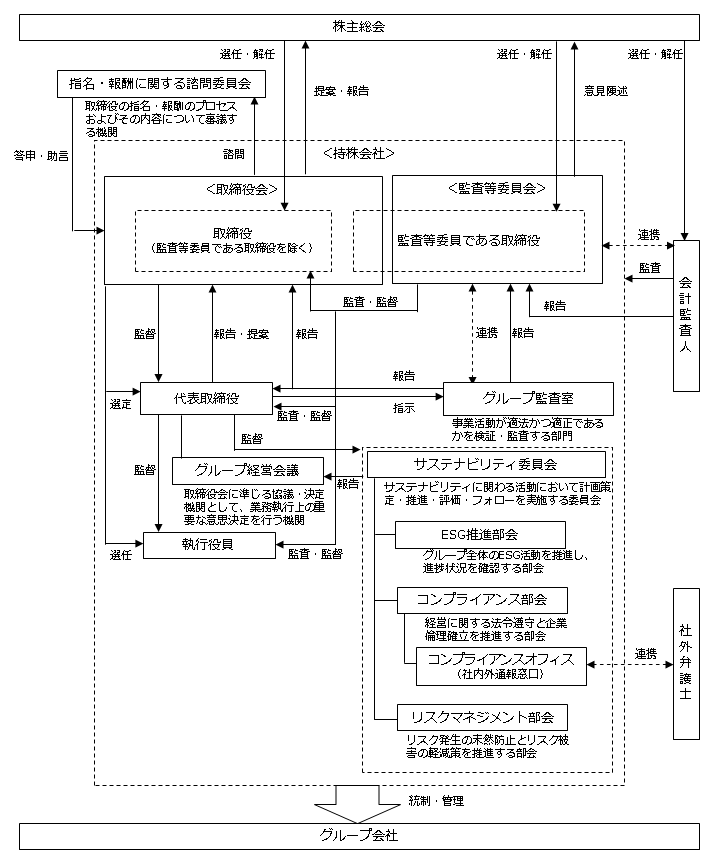
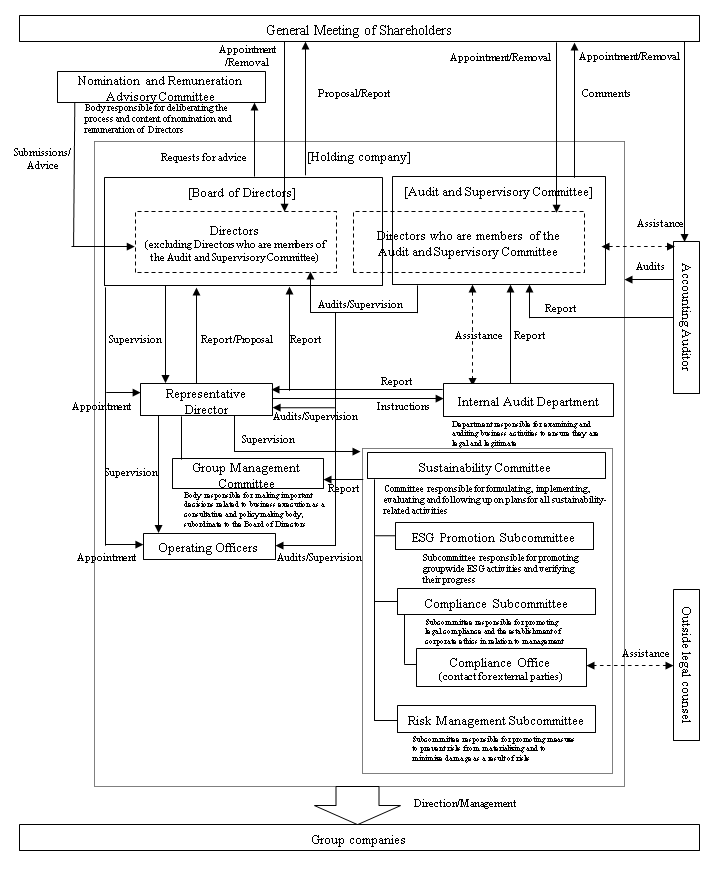
Main organization/meeting structure and roles
| Main organization/meeting system | Structure | role |
|---|---|---|
| Board of Directors FY2025 Number of times: 17 Tenure: 1 year |
Chairperson: President and Representative Director Members: 11 members (including 3 women), including Director 7 (including Outside Director 4 members) who are not members of the Audit and Supervisory Committee and Director 4 members (including Outside Director 3 members) who are members of the Audit and Supervisory Committee |
It is held once a month as an important decision-making body for the management of the entire group, and also holds extraordinary meetings as necessary to decide on matters stipulated by law and important management matters, and to review the status of business execution. I am supervising. |
| Audit and Supervisory Committee FY2025 Number of times: 13 times Term: 2 years |
Members: 4 Audit & Supervisory Committee members (including Outside Director 3) | In cooperation with the Group Internal Audit Office and Accounting Auditors, which are internal audit departments, we audit the legality and appropriateness of the execution of Director 's duties. In addition to regular Audit and Supervisory Committee reports, information exchange meetings are held with the Group Audit Office, which is the internal audit department. In addition to reporting audit results with Accounting Auditors, we also hold information exchange meetings from time to time. |
| Group Management Committee FY2025 Number of events: 26 times |
Members: Internal Director, full-time Audit and Supervisory Committee members, Operating Officers who supervise or are in charge of important management functions, and presidents of core operating companies | Group Management Committee is a consultative and decision-making body in accordance with the Board of Directors and makes important decisions in the execution of business. In addition, since the Group Management Committee mainly discusses the Group's business strategy and business execution issues and performance, the Operating Officers in charge of technology, R&D, and intellectual property, Operating Officers in charge of finance, and the Human Resources Department president who do not attend the Board of Directors, as well as the core operating companies TOYOCOLOR Co., Ltd., TOYOCHEM Co., Ltd., and TOYO INK Co., Ltd. Director is always present. |
| Nomination and Remuneration Advisory Board FY2025 Number of times: 6 times |
Chairperson: Outside Director |
Director Discusses candidates and their compensation. The committee, which is majority-headed by Outside Director, advises Board of Directors on the appointment and remuneration of officers, thereby further enhancing transparency and objectivity in the process of determining the nomination and remuneration of Director and its contents. |
Composition and activity status of major meetings by Director (as of March 24, 2026)
◎: Chairperson/Chairperson ◯: Members
| Composition of the meeting body and attendance status in FY2025 | ||||
|---|---|---|---|---|
| position | Name | Board of Directors | Audit and Supervisory Committee | Advisory Committee on Appointment and Remuneration |
| President and Representative Director Group CEO |
Satoru Takashima | ◎ (17/17) |
― | ○ (6/6) |
| Director Vice President In charge of general management and corporate divisions |
Hiroyuki Hamada | ○ (17/17) |
― | ― |
| Independent Outside Director | Tomoko Adachi | ○ (17/17) |
― | ○ * 2 |
| Independent Outside Director | Yoshinobu Fujimoto | ○ (17/17) |
― | ― |
| Independent Outside Director | Yukihiro Tachihuji | ○ (13/13) * 1 |
― | ○ (5/5) * 1 |
| Independent Outside Director | Megumi Tsukamoto | ○ * 2 | ― | ― |
| Director In charge of quality assurance, production, environment, sustainability, purchasing, and logistics |
Yumoto Nakajima | ○ * 2 | ― | ― |
| Director, Audit and Supervisory Committee member (full-time) | Masayuki Kano | ○ (17/17) |
◎ (13/13) |
― |
| Leading Independent Outside Director | Yutaka Yokoi | ○ (17/17) |
○ (13/13) |
◎ (6/6) |
| Independent Outside Director | Minoru Matsumoto | ○ (17/17) |
○ (13/13) |
― |
| Independent Outside Director | Noriko Kosugi | ○ (13/13) * 1 |
○ * 2 | ― |
* 1 Appointed on March 26, 2025
* 2 Inaugurated on March 24, 2026
List of officers (reasons for selection/skill matrix)
Standards Concerning the Independence of Outside Officers
Complying with the Corporate Governance Code
Evaluation of the effectiveness of Board of Directors
Every year, the Company conducts an evaluation of the effectiveness of the Board of Directors of all Director, including outside officers, and works to improve the Board of Directors based on the issues identified.
Issues identified in the past two years and initiatives implemented
Initiatives to address issues in the FY2023 Effectiveness Evaluation
Based on the opinion that the composition of the Board of Directors should be made up of more people with business experience, two new candidates with high knowledge of management and finance were selected as Outside Director candidates at the 187th Regular General Shareholders’ Meeting to be held in March 2025.
Initiatives to address issues in the FY2024 effectiveness evaluation
- Expectations for Director There were suggestions and points for operational improvements to enhance discussions at Board of Directors, etc., such as clarifying the points of discussion according to the role and enhancing the provision of information from the executive side. In response to this point, we conducted multiple new small meetings with Outside Director the chairman and internal officers and staff, and reviewed the way materials were provided to Outside Director.
FY2025 Effectiveness Evaluation Process (October 2025 ~ March 2026)
- In October 2025, we conducted a questionnaire with the involvement and advice of a third-party external organization.
- Based on the results of questionnaires compiled by external organizations, we held a discussion to improve Board of Directors operations at the Board of Directors held in December 2025.
- At the Board of Directors held in March 2026, we decided on our policy for FY2026 based on the results of the questionnaire and discussion.
Results and Issues of the FY2025 Effectiveness Evaluation
- After past improvements, we received generally positive evaluations, such as feeling that the effectiveness of Board of Directors has increased, and we recognized that the overall effectiveness of Board of Directors has been ensured.
- In the FY2025 effectiveness evaluation, we made suggestions and points for Board of Directors discussions, such as enhancing discussions on medium- to long-term management policies and the need to strengthen monitoring. In response to this point, we plan to review the annual agenda for Board of Directors in fiscal 2026 to enhance deliberations, including medium- to long-term management policies, and further strengthen communication between Director.
Our Board of Directors will respond to the issues identified in this evaluation and grasp the status of improvement in the evaluation from the following fiscal year onward, and strive to continuously improve its effectiveness.
Executive compensation system
The Company recognizes the executive compensation system as an important matter in corporate governance, and has established the system based on the following basic policy, and operates the system while incorporating an objective perspective through Advisory Committee on Appointment and Remuneration Masu.
- The level must be in consideration of the balance with economic conditions and business results.
- Must be at a level that allows us to secure excellent managers to increase corporate value.
- A remuneration system that embodies the management philosophy and reflects the medium- to long-term management strategy, and strongly motivates sustainable growth.
- Incorporate a system that reflects performance linkage and motivates the achievement of public performance.
- Designed with fairness and rationality from the perspective of accountability to stakeholders, and decisions made through an appropriate process with increased objectivity and transparency.
Decision process for executive compensation system
Director The policy for determining the details of remuneration for each individual (excluding Director, who is a member of the Audit and Supervisory Committee) is decided by Board of Directors after deliberation by the Advisory Committee on Appointment and Remuneration, chaired by Outside Director.
Overview of executive compensation
From the perspective of focusing on Director Outside Director ensuring transparency, our company's Director remuneration consists of "basic remuneration," "performance-based remuneration," and "restricted stock remuneration." It consists of "rewards". The total remuneration for Director (excluding Director who are members of the Audit and Supervisory Committee), as resolved at the Ordinary General General Shareholders’ Meeting held on March 23, 2022, shall be no more than 500 million yen per year (including no more than 100 million yen Outside Director), and no more than 100 million yen for outside directors. The total remuneration for a certain Director is less than 100 million yen per year. Additionally, the total amount of monetary remuneration claims to be paid as restricted stock compensation to Director (excluding Director who are audit and supervisory committee members and Outside Director) is set at 100 million yen or less per year, in addition to the 500 million yen per year limit. .
- Basic remuneration is a monthly fixed remuneration in cash and is determined based on position.
- Performance-linked remuneration is paid in cash on a monthly basis as short-term incentive remuneration by reflecting the evaluation of consolidated business results. Internal Director who are not Audit & Supervisory Committee members are eligible for payment.
- Restricted stock compensation is a long-term incentive compensation that shareholders share with shareholders and further increase their motivation and contribution to improving the Company's medium- to long-term business performance and increasing corporate value by demonstrating a sound entrepreneurial spirit. Internal Director who are not Audit & Supervisory Committee members are eligible for payment.
Percentage of each compensation component (standard amount when 100% of the performance-linked compensation target is achieved)
| Base Compensation (Fixed Compensation) |
Performance-linked compensation (Variable Compensation) |
Restricted stock compensation (Variable Compensation) |
|
|---|---|---|---|
| President and Representative Director | 50 | 35 | 15 |
| Other than those listed above, Director (except Outside Director and Director who are Audit and Supervisory Committee members. ) | 60 | 30 | 10 |
| Outside Director and Audit & Supervisory Committee Members Director | 100 | ー | ー |
Director and Amount of Audit & Supervisory Committee Members' Remuneration (FY2025)
| Officer classification | Total amount of remuneration, etc. (One million yen) |
Total amount of compensation by type (million yen) | Number of eligible officers (given name) |
||
|---|---|---|---|---|---|
| fixed remuneration (basic remuneration) |
variable compensation (performance-based compensation) |
With transfer restrictions stock compensation |
|||
| Director (excluding Director who are audit and supervisory committee members) (including Outside Director) |
260 (42) |
174 (42) |
74 (-) |
11 (-) |
10 (6) |
| Director (Audit and Supervisory Committee Member) (including Outside Director) |
58 (33) |
58 (33) |
- | - | 4 (3) |
| sum (Outside Director of which ) |
318 (76) |
233 (76) |
74 (-) |
11 (-) |
Total 14 (9 in total) |
* The above amount includes the three Director who resigned at the end of the regular General Shareholders’ Meeting on March 26, 2025.
Thoughts on cross-shareholdings
Every year, we examine the economic rationality of cross-shareholdings in Board of Directors. We will examine the benefits of holding the stock compared to the cost of capital and the transaction status of each individual stock, and if we determine that the holding of the stock is not appropriate, we will proceed with the reduction of the number of stocks after taking into account the situation of the company concerned and market trends.
In addition, even if we do not judge that the significance of holding individual stocks has diminished, if they contribute to improving the capital efficiency of the Group as a whole, we will consider reducing them as appropriate and proceed with the sale after careful dialogue with the issuing company, thereby further reducing the number of shares held.
With regard to the exercise of voting rights for cross-shareholdings, the Company shall exercise voting rights appropriately for each proposal, taking into account qualitative and comprehensive considerations such as whether each proposal contributes to the medium- to long-term enhancement of the corporate value of the issuing company, whether it contributes to the common interests of shareholders including the Company, and the impact on the management and business of the Group. In addition, if there are special circumstances such as significant damage to corporate value or serious compliance violations at the issuing company, or if there is a concern that the corporate value of the Company as a shareholder will be impaired, the Company will carefully decide whether to approve or reject the proposal after gathering sufficient information through dialogue with the issuing company.
Investment stocks held for purposes other than pure investment purposes
| Number of brands (Brand) |
of the amount recorded on the balance sheet Total amount (million yen) |
|
|---|---|---|
| Unlisted stocks | 47 | 948 |
| Stocks other than unlisted stocks | 34 | 20,008 |
Information on the number of shares for each issue of specified investment stocks and deemed shareholdings, the amount recorded on the balance sheet, etc.
| Brand Name | Current fiscal year | Previous business year | Purpose of holding, outline of business alliances, quantitative holding effect, and reason for the increase in the number of shares | Whether or not you own shares of our company |
|---|---|---|---|---|
| Number of shares (shares) | Number of shares (shares) | |||
| Amount recorded on balance sheet (million yen) | Amount recorded on balance sheet (million yen) | |||
| NIPPON SHOKUBAI CO., LTD. | 3,618,188 | 3,618,188 | We hold this property for the purpose of stable procurement of raw materials. | Yes |
| 7,256 | 6,928 | |||
| Toyo Seikan Group Holdings, Ltd. | 1,598,969 | 1,598,969 | We are engaged in transactions in polymer coatings related businesses, and we hold them for the purpose of maintaining and strengthening business relationships. | Yes |
| 6,117 | 3,847 | |||
| Kyodo Printing Co., Ltd. (Note 1) | 867,680 | 216,920 | We are engaged in transactions in package-related businesses, and we hold them for the purpose of maintaining and strengthening business relationships. | Nothing |
| 1,371 | 874 | |||
| Marubeni Corporation | 266,851 | 266,851 | We hold this property for the purpose of stable procurement of raw materials. | Nothing |
| 1,161 | 638 | |||
| OSAKA ORGANIC CHEMICAL INDUSTRY LTD. | 174,000 | 174,000 | We hold this property for the purpose of stable procurement of raw materials. | Yes |
| 696 | 503 | |||
| Nissha Co., Ltd. | 435,000 | 435,000 | We are engaged in transactions in package-related businesses, and we hold them for the purpose of maintaining and strengthening business relationships. | Yes |
| 543 | 709 | |||
| LINTEC Corporation | 100,000 | 100,000 | We are engaged in transactions in polymer coatings related businesses, and we hold them for the purpose of maintaining and strengthening business relationships. | Nothing |
| 442 | 306 | |||
| TOMOKU CO., LTD. | 108,033 | 108,033 | We are engaged in transactions in package-related businesses, and we hold them for the purpose of maintaining and strengthening business relationships. | Yes |
| 381 | 250 | |||
| ARAKAWA CHEMICAL INDUSTRIES, LTD. | 293,760 | 293,760 | We hold this property for the purpose of stable procurement of raw materials. | Yes |
| 358 | 324 | |||
| Toin Corporation | 212,551 | 210,763 | We are engaged in transactions in the printing and information-related business, and hold the business for the purpose of maintaining and strengthening business relationships. The number of shares has increased due to the continued participation in the holding association of our business partners. | Nothing |
| 251 | 136 |
*1 As of April 1, 2025, Kyodo Printing Co., Ltd. has split its shares at a ratio of 4 shares per share of common stock.
Dialogue with Shareholders and Investors
The Company considers shareholders and investors to be important stakeholders, and in addition to disclosing information in a timely and appropriate manner, the Company engages in sincere dialogue with shareholders and investors in order to achieve sustainable growth and increase corporate value, and utilizes the valuable opinions it receives to improve management.
The basic policy and the establishment of systems and initiatives to promote constructive dialogue are clearly stated in the "Basic Policy on Corporate Governance" (Article 17, Dialogue with Shareholders), and we will continue to implement them based on this policy.
Information disclosure is carried out proactively and fairly in accordance with the Information Disclosure Policy.
Details of IR and SR activities (FY2025)
The main IR and SR activities in FY2025 (fiscal year ending December 2025) are as follows.
Primary responders
Group CEO, Director in charge of Corporate Division, Operating Officer in charge of investor relations, Officers in charge of business, Department in charge of Investor Relations, Department in charge of ESG, SR Department in charge of SR, etc.
Summary of shareholders and investors engaged in dialogue
Domestic and Overseas Institutional Investors, Securities Analysts, Individual Investors
Main activities
| activity | number of times | details |
|---|---|---|
| Financial results briefings for analysts and institutional investors, business briefings | 4 times |
|
| Individual interviews with domestic and overseas institutional investors, proxy voting officers, and analysts | About 120 times in total | Individual interviews were conducted on a visit, in the office, and online (WEB or telephone). |
| Briefing for Individual Investors | 2 times | Briefings were held and presentation materials were posted on the website for individual investors. |
| General Meeting of Shareholders | 1 time | Conducted hybrid participatory virtual General Shareholders’ Meeting. |
| Disseminating information on the website | suitability | Financial results briefings, financial results briefing materials, General Shareholders’ Meeting-related materials, video distribution and transcription, securities reports, semi-annual reports, integrated reports, shareholder communications (to shareholders), timely disclosure materials, etc. Sponsored Research Report (4 times a year, Japanese and English) |
Key themes and interests of the dialogue
- Financial Results and Future Outlook
- Medium-Term Management Plan artience 2027 Strategy and Progress
- Initiatives for management that is conscious of the cost of capital and stock price, especially to improve ROE and PBR
- Capital Policy, Cash Allocation, and Shareholder Returns
- Disclosure of Responses to Climate Change
- Board of Directors Structure and activity status
- How to calculate executive compensation
- Voting Decisions on the Exercise of Voting Rights at Regular General Shareholders’ Meeting
Implementation of feedback to management and Board of Directors
- The Director in charge of corporate divisions reported on the opinions and dialogues of institutional investors and analysts on Board of Directors. Share information, discuss and provide feedback with Director and Outside Director. (Semi-annually)
- Quarterly reporting of dialogue to management and related departments.
- Reporting on the contents and results of individual investor briefings (on a case-by-case basis)
Matters incorporated based on dialogue and feedback
- Update of the plan in the Medium-Term Management Plan artience 2027
- Reduction of shareholdings and implementation of additional shareholder returns
- Holding factory tours for institutional investors
- Enhancement of financial results briefing materials and supplementary financial results briefing materials
- Ink business briefing session
- Board of Directors configuration review
- Conduct regular SR interviews
- Revision of the process for determining the amount of compensation for each person in Director
- Review of the executive compensation system
Share


