
Compliance
This website uses automated machine translation. Please note that translations may not be fully accurate and may differ from the original Japanese text.
- Basic approach
- Promotion system
- Whistleblowing system
- attempt
- Prevention of corruption and corruption
- fair dealing
Basic approach
Based on the belief that it is important for each and every employee to think about compliance, artience group 's compliance activities aim to steadily spread awareness of legal compliance by repeatedly discussing compliance through daily operations.
In January 2024, in line with the change of company name and some changes in our philosophy, we reviewed our sustainability-related policies and guidelines, revised the "CSR Charter" to the "Sustainability Charter," and reorganized and revised the "Code of Business Conduct," which had previously been used as explanatory materials in our compliance activities, as the "Code of Ethics and Conduct." In addition, we have formulated a new "Basic Policy on Compliance" (established on May 10, 2024).
- The "Sustainability Charter," "Code of Ethical Conduct," "Basic Policy on Respect for Human Rights," and "Basic Policy on Occupational Safety and Health" have been made multilingual (a total of 15 languages) and available as PDFs. We plan to further multilingualize in the future
The “artience Group Code of Ethical Conduct” (hereinafter referred to as this “Code”) outlines the basic ways of thinking and conduct that should be observed in order for officers, corporate advisors, employees, contract employees, and part-time employees of the artience Group (hereinafter referred to as the “Group,”) as well as temporary dispatch workers and all other persons engaged in the Group’s business operations (hereinafter referred to collectively as “officers and employees”) to be suitable members of society as the Group requires. Based on compliance with this Code in all of its business activities, the Group will contribute to improving the sustainability of society and work to realize the Group’s philosophy of “Creating value that resonates with the senses, building a future where all people can live enriched lives.”
- Compliance with laws, regulations, and internal rules, etc., and respect for international codes of conduct
- We will comply with the laws and regulations of the countries and regions in which we conduct business activities, comply with internal rules, etc. (including this Code), and respect and comply with international codes of conduct*.
- We will make decisions based on high standards of reason, conscience, and ethics, and act with sincerity, in line with the trust placed in us by society.
- In the event that laws and regulations applicable in a particular country or region conflict with this Code or various internal regulations, we will pursue ways to respect international codes of conduct to the maximum extent possible, to the extent that doing so does not violate local laws and regulations.
- International codes of conduct: refers to customary international law, the generally accepted principles of international law, and expectations for the socially responsible behavior of companies, as deduced from agreements between governments, including universally accepted treaties and conventions. Examples include the UN Universal Declaration of Human Rights, the Ten Principles of the UN Global Compact, the UN Guiding Principles on Business and Human Rights, the Sustainable Development Goals (SDGs), the ILO International Labour Standards, the ILO Tripartite Declaration of Principles concerning Multinational Enterprises (MNE Declaration), and the OECD Guidelines for Multinational Enterprises.
Reference: [Basic Policy on Compliance], [Basic Policy on Risk Management], [Basic Policy on Development of Internal Control System]
Reference: [Sustainable Supply Chain Guidelines] 1. Respecting the Laws and Internationally Recognized Standards - Respect for human rights
- We will respect the human rights of all people based on the Group’s Corporate Philosophy of “People-oriented management.” We will not violate human rights, be complicit in human rights violations, and will endeavor not to create situations that encourage human rights violations.
- We will not tolerate child labor or forced labor throughout the Group’s supply chain. We will not tolerate any form of modern slavery, including debt labor or human trafficking, inhumane treatment, or unfair labor practices.
- We respect the dignity and diversity of individuals, and do not discriminate for any reason * that seeks to deny it, conduct that may lead to discrimination, or conduct that is legally or socially defined as harassment.
- We will understand the cultures, customs, and religious customs of the countries or regions in which we operate, and act with respect for them.
- To eliminate complicity or the possibility of complicity in human rights violations, we will not procure or use so-called conflict minerals, agricultural products for which there is concern about human rights violations, and raw materials derived from them.
- Discrimination that seeks to deny the dignity and diversity of individuals for any reason: includes, but is not limited to, reasons such as race, color, ethnicity, national origin, region of origin, social background, age, gender, sexual orientation, gender identity and expression, philosophy, creed, religion, political affiliation or political opinion, disability, military service status, union membership, employment type, academic background, marital status, family circumstances, state of health and genetic information.
Reference: [Sustainable Supply Chain Guidelines] 2-1. Prohibiting Forced Labor and Freely Chosen Employment / 2-2. Prohibiting Child Labor and Respecting the Rights of Young Workers / 2-5. Prohibiting Inhumane Treatment / 2-6. Prohibiting Discrimination / 5-9. Responsible Sourcing of Minerals and Avoidance of Complicity in Human Rights Violations - Prohibition of Corrupt *
- We will not offer, demand, promise, provide, or accept bribes, either directly or indirectly, to public officials, agents of public officials’ duties, or employees in posts with public interest or public nature equivalent to those of public officials.
- Even in cases where it does not constitute bribery, we will not give customers or business partners excessive gifts or entertainment that exceeds the scope of socially accepted norms.
- We will not make illegal or inappropriate political contributions. In particular, in order to maintain the political neutrality of the Group, we will not use any company property as political contributions to any political parties, political groups, or candidates for public office.
- We will not engage in conflicts of interest * that harm corporate interests and enjoy personal interests in situations where individual interests and company interests conflict.
- We will not engage in insider trading based on non-public information of customers or business partners obtained through the Group or our business operations. We will not provide non-public information to family members or third parties, or solicit insider trading.
- Acts of corruption: include, but are not limited to, bribery, excessive gifts or entertainment, conflicts of interest, wrongful receipt of rebates or kickbacks, facilitation payments to obtain unfair profits, illegal or inappropriate political contributions, anti-competitive acts such as bid-rigging or collusion, abuse of a dominant position that disadvantages business partners, extortion, blackmail, embezzlement, breach of trust, fraud, obstruction of justice, insider trading, and money laundering.
- Acts in conflict of interest: include labor practices on behalf of competitors, sales of competing products or services for personal benefit or the benefit of a third party, business activities unrelated to the company during working hours (excluding the exercise of civil rights, etc.,) and transactions between officers and employees and the company.
Reference: [Policy on Anti-corruption]
Reference: [Sustainable Supply Chain Guidelines] 5-1. Preventing Corruption / 5-2. Prohibiting Inappropriate Provision and Improper Benefit - Fair and sound business activities
- We will engage in fair, transparent, and free competition in accordance with the laws and regulations, international codes of conduct, and business practices applicable in the countries and regions in which we operate, and will not engage in any behavior that hinders these activities.
- We will not engage in unfair transactions such as cartels, bid rigging, discriminatory consideration, unfairly cheap sales, unfairly high-priced purchasing, or other behavior that may hinder competition.
- In advertisements, promotional materials and catalogs relating to products and services, we will not use expressions that differ from the facts, expressions that cause customers or consumers to misunderstand the facts, or expressions that lead to the defamation of others or infringement of their rights.
- We will not take advantage of our dominant position as a purchaser or outsourcer / subcontractor in commercial transactions to unilaterally disadvantage business partners. We will conduct transactions with good faith, fairness, and equity, based on contracts, in accordance with laws and regulations.
- We will appropriately manage tangible and intangible company assets * and will not use them for any purpose other than our business activities. In particular, we will not use it for any purpose that may damage the company's profits, such as unauthorized use or personal diversion.
- We will not improperly or immaterially report, falsify, or manipulate information such as documents and data that are managed and used in our business activities, including financial reports, accounting documents, research reports, sales reports, expense accounts, and attendance logs.
- Tangible and intangible company assets: Tangible company assets includes land, buildings, company supplies, equipment / facilities, cash, and securities. Intangible company assets include intellectual property rights, customer and sales information, technical information, production information, and brand power.
Reference: [Basic Policy on Compliance], [Policy on Anti-corruption]
Reference: [Sustainable Supply Chain Guidelines] 5-6. Fair Business Activities / 5-7. Prohibiting Abuse of Superior Bargaining Position - Appropriate information management
- We will appropriately and strictly manage and protect important information (confidential information) relating to the Group, and that received from our customers and third parties. We will not acquire or use the confidential information of other companies by wrongful means.
- We will respect the intellectual property rights of others, including our customers and business partners, and endeavor not to infringe upon them. In conducting our business activities, we will conduct reasonable preliminary investigations to avoid infringing upon the intellectual property rights of others.
- We will respect the person of individuals and appropriately acquire, use, manage, and protect all personal information in accordance with the laws and regulations of the countries and regions in which we operate.
- We will thoroughly implement preventive actions based on the perspective of information security in our daily operations, and endeavor to prevent damage not only to the Group but also to our customers and business partners.
- We will provide accurate information to all customers about products and services that does not lead to misunderstandings. In particular, if a risk to quality or safety is anticipated, we will disclose information promptly and appropriately.
Reference: [Basic Policy on Information Security], [Disclosure Policy (Policy on Information Disclosure)], [Privacy Policy (Policy on Personal Information Protection)]
Reference: [Sustainable Supply Chain Guidelines] 5-5. Respecting Intellectual Property Rights / 6-3. Providing Accurate Information on Products and Services / 7. Information Security - Separation from antisocial forces
- We will not engage in any relationship whatsoever with antisocial forces or antisocial activities that threaten social order and safety, or hinder sound social and economic activities.
- We will take a resolute stance against antisocial forces and will not engage in any transactions or answer to any unreasonable demands, such as for the provision of money or purchase of goods.
Reference: [Sustainable Supply Chain Guidelines] 5-3. Prohibiting Involvement with Antisocial Forces - Responsibilities as members of a global chemical company
- We will confirm that all transactions involving the Group’s products do not violate laws and regulations relating to security export control for the purpose of maintaining international peace and security, and that they are not used for weapons development, etc.
- We recognize that the consequences of violating laws and regulations relating to security export control are not limited to criminal and administrative sanctions, but also affect the survival of the company itself, and will engage in appropriate export control in accordance with laws and internal regulations.
- We will engage in appropriate chemical substance control to ensure that chemical substances contained in the Group’s products and raw materials do not affect human health or the environment.
- We will obtain information on hazards and safe handling of chemical substances in all processes, from raw material procurement to disposal, and endeavor to provide appropriate information to employees and customers involved with our products.
Reference: [Basic Policy on Environment], [Basic Policy on Chemical Substance Control]
Reference: [Sustainable Supply Chain Guidelines] 4-3. Chemical Substance Management / 10-3. Proper Import / Export Control - Responsibilities as members of a listed company or its group companies
- We reaffirm that the management of our company, as a listed company, is entrusted to us by our shareholders, and will endeavor to respond appropriately to this mandate. We will carry out our respective duties with responsibility for the enhancement of the Group’s brand and corporate value.
- We will disclose important information about the management of the Company and the Group to shareholders, investors, and other stakeholders in a fair, timely, and appropriate manner.
- We will comply with the principle of shareholder equality and will not engage in transactions or behavior contrary to the interests of other shareholders, such as providing special benefits or profits to specific shareholders.
Reference: [Guidelines for Timely Disclosure of Corporate Information]
Revision, abolition and management
Decisions regarding the revision or abolition of this Code will be made by the board of directors of artience Co., Ltd.
The revision and abolition of this Code will be carried out by the administrative office of the Sustainability Committee, which oversees the group-wide sustainability activities of the artience Group.
Established on October 1998
Revised on January 1, 2024 (resolved at the Board of Directors on December 8, 2023)
Revised on May 10, 2024 (as a partial amendment, reference materials were added to some articles.)
The artience Group (hereinafter referred to as the “Group”) believes that it is of the utmost importance for compliance activities as a company that each and every employee considers compliance. By holding discussions and sharing opinions on compliance through daily operations, we aim to create a state where awareness of legal compliance and respect for social norms is steadily instilled throughout the Group.
Based on this basic approach, we have established this Basic Policy on Compliance (hereinafter referred to as this “Basic Policy.”) In accordance with this Basic Policy, we will ensure thorough compliance in our global business activities to form a corporate foundation that contributes to the sustainable growth of the Group and the maintenance and improvement of its brand.
- Scope of application
This basic policy applies to all companies and organizations that make up the Group. At the same time, it also applies to officers, advisors, employees, contract employees, part-time Thailand employees, temporary employees, and all other persons engaged in the business of the Group (hereinafter collectively referred to as "officers and employees, etc."). In addition, we will ask all suppliers, business partners, and other related parties that make up the Group's supply chain to understand and support this basic policy.
- Scope of Compliance
The Group believes that the essence of compliance management is to face all stakeholders in good faith. Based on this, in addition to complying with the laws and regulations applicable in the countries and regions in which we operate, the Group will comply with and respect the following norms.
(1) Internal Regulations: The Group's own management philosophy, work rules, internal regulations, rules, policies, manuals, etc.
(2) Social norms: Rules based on international norms of conduct and values (common sense, morality, etc.) that are universally recognized in general society (including those that are not codified)
(3) Corporate ethics: Ethics of the market economy, habits and discipline in sound business transactions, and professional ethics with integrity and fairness - Prohibition of non-compliance
The Group prohibits officers and employees from committing any organizational or individual compliance violations in any corporate activities, including the Group's business activities. In addition, it is prohibited to instruct, induce, or solicit such violations.
Officers and employees shall not be exempted from liability for committing such violations on the grounds that they did not have knowledge of compliance, had no intention of violating the law, or were for the purpose of advancing the interests of the Group. - Establishment and operation of a compliance system
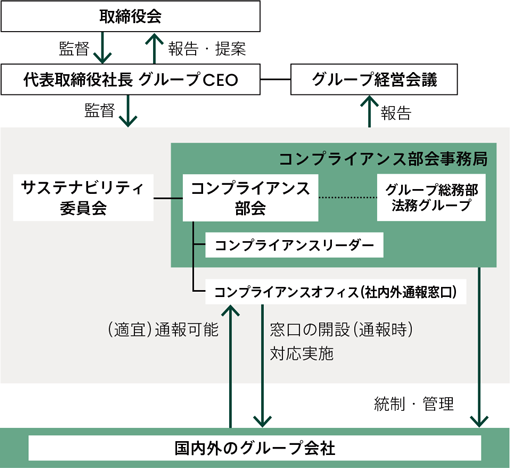
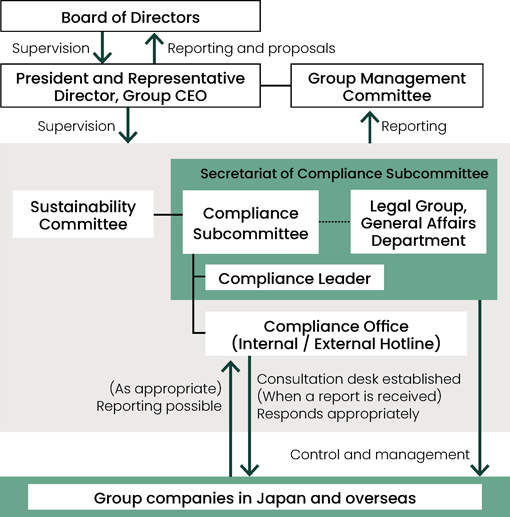
The Group will establish and operate a company-wide compliance system centered on Compliance Committee, a subordinate organization of Sustainability Committee supervised by the Company's Board of Directors and President and Representative Director, and will promote the planning and promotion of company-wide compliance activities, internal enlightenment and education, information dissemination, and compliance with laws and regulations and the establishment of corporate ethics in management.
- Establishment and operation of a whistleblowing hotline
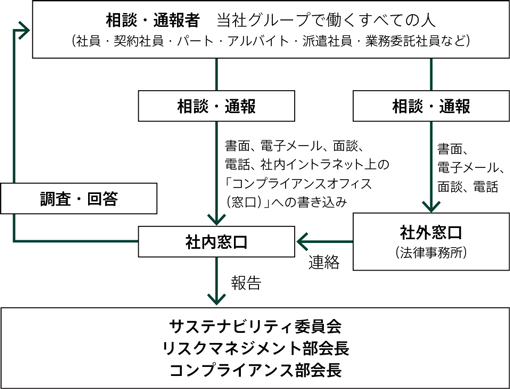
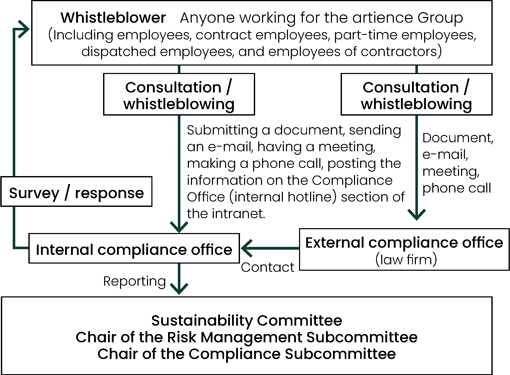
The Group establishes a system for the appropriate handling of consultations and reports regarding compliance violations, and encourages the prevention of the occurrence of violations, early detection, and correction through self-purification. To this end, we will establish and operate a whistleblowing hotline based on a fair and appropriate system.
The Group ensures the anonymity of those who use the whistleblowing hotline and those who cooperate with investigative activities related to consultations or reports (hereinafter collectively referred to as "whistleblowers, etc.") by imposing a duty of confidentiality on those who conduct investigations related to consultations or reports received by the whistleblowing hotline. In addition, we will protect whistleblowers from unfair personnel evaluations, disciplinary measures, reassignments, and other disadvantageous treatment based on the fact that whistleblowers have consulted, reported, or cooperated, as well as acts that harm the work environment of whistleblowers, such as harassment, harassment, and slander. - Education and penetration
The Group will ensure that compliance is known throughout the Group by preparing this Basic Policy, the Code of Ethics and Conduct, various policies and regulations related to compliance, and educational materials related to compliance, etc., and making them available at all times through internal handouts and the intranet.
- Remedies and penalties
In the event that an officer or employee who has committed or been involved in a compliance violation is directly employed by the Group, the Group will strictly and promptly punish them, regardless of their position or position, in accordance with the rules and employment regulations of the Company or each Group company. In the event that such officers and employees are persons other than those directly employed by the Group, the Company requests that the Company deal strictly with such officers and employees in accordance with the business consignment agreements concluded between the employer of the such person and the Group.
- Revision, abolition and management
The revision or abolition of this basic policy will be decided and decided by the Board of Directors of the artience Co., Ltd..
In addition, the department in charge of the revision and abolition of this basic policy shall be the department that supervises the compliance activities of artience Co., Ltd..
Established on May 10, 2024 (resolved at the Board of Directors on May 10, 2024)
Promotion system
Sustainability Committee Compliance Committee take the lead in planning compliance activities, disseminating ideas on compliance, and providing education on laws and regulations throughout the company. In addition, compliance leaders at each site take the lead in actively providing opportunities to raise awareness of compliance related to daily operations.
Whistleblowing system
We have established "Compliance Office" both internally and externally as consultation and reporting desks related to compliance, and have established "Compliance Office Operational Regulations" to ensure the fair and appropriate operation of consultation and reporting desks. We are subject to consultation and reporting, focusing on violations of laws and regulations (including corruption such as bribery and violations of antimonopoly laws) and violations of internal regulations.
With the utmost consideration for the protection and confidentiality of consultees and whistleblowers, we investigate the facts of inquiries and reports received, and promptly take measures if there is a concern that a problem may occur. In FY2024, there were 7 consultations and reports related to harassment and violations of internal regulations, but none of them led to significant risks.
attempt
- First-half compliance base meeting held (March to June)
- Compliance Strengthening Month (October)
- Compliance education
- Compliance audit aimed at building an honest organization
- Responding to overseas legal risks
Prevention of corruption and corruption
Prevention of corruption and corruption